Unattributed

Features

Originally Published: 2025-03-11 Closeup of a man wearing a wristwatch

Introduction

It really wasn't all that long ago that keeping track of the time was not as passive as it is today. Back in the 1980s, a mere 40 years ago, cell phones weren't prevalent. Even desktop and laptop computers were still prone to needing to have their time checked.

This was especially true when the Daylight Savings Time changes happened twice a year. And this is the story of how I, despite having recently undertaken a time-based hobby, nearly missed this event.

The Importance of Daylight Savings Time

Given how technology has made the shift between Standard Time and Daylight Saving Time so automatic and seamless to most of our lives, we have lost the significance of this event. However, it really is still a very specific event that has some fairly major implications.

The easily understood part of Daylight Saving Time (DST) is that it is based on the fact that the earth rotates on a tilted axis, and as we orbit the sun the length of daylight shifts throughout the year. Therefore, we adjust our clocks when there are fewer daylight hours during a day in order to take advantage of that daylight.

But there is quite a bit more to the changing of the clocks than meets the eye. The Romans used a system of changing hour lengths with their water clocks to account for the changing of daylight periods throughout the year. The National Assembly in Spain moved meetings an hour forward from May-September in order to account for the changes in daylight.

However, it wasn't until 1895 when entomologist George Hudson submitted a paper proposing the changing of the clocks to the Wellington Philosophical Society of New Zealand that anyone considered the idea. Hudson had come up with the idea in order to have more post-work daylight available to him for collecting insects. In 1907 William Willet independently proposed the same idea, and would publish a paper with the concept a few years later.

Port Arthur, Ontario, Canada was the first city to actually implement DST in 1908, followed by Orillia, Ontario in 1911. The German Empire and Austria-Hungary were the first states to implement the time change in 1916.

The importance of time keeping, however, had not fully been realized yet. It would become a major thing that was necessary, however, with the invention of the railroad, and the need to time trains accurately. Standard Time / Daylight Saving time also played a part in World War I.

There's a lot more detail regarding the history of Daylight Saving Time, which a brief read on Wikipedia can fill in.

My Time Story

Throughout the years, I have been embracing my role as a “technology curmudgeon”. That is to say, that I don't have an appreciation of the advancement of technology for the sake of the advancement of technology. However, that doesn't mean that I am totally against the advancement of technology, just that I want to see a proof of the value of the advancement before integrating it into my life.

For example, the furor over NFT's a few years ago. There was no way in which I saw them as having any value, or fitting into or improving most lives in any substantive ways. The same goes for Crypto Currency. At one time I was actually more interested in Crypto, as I saw some projects that had potential to add value. In particular Namecoin, which initially proposed to be a censorship-proof method of handling the Domain Name System, which is extremely important to the internet as we know. However, this project has failed to gain recognition by ICANN the controlling entity for domain names, and therefore has only been able to handle .bit domains outside the ICANN registry.

Even cell phones were initially a hard sell for me. I didn't see the use for them initially. That was until there was real development in the Smartphone market, and it started replacing numerous forms of communication, including text messaging, beepers and regular telephones. By the time the iPhone was announced it was clear that cellphone technology was here to stay, and I adopted it.

However, that doesn't mean that I have adopted everything related to cellphones that have happened over the years. Google Glass? Nah, I didn't see where people really wanted or needed Augmented Reality. Then there were the fitness trackers / watches that begat the Apple Watch.

This was a whole area that I didn't go for. Why? The issues surrounding technology, applications, and the amount of information that you are giving up when using them has become a convoluted mess. And something that I generally don't want to deal with.

But, after doing some investigation into smartwatches, I did decide that I wanted to wear a watch again — which I hadn't done for years and years.

How I Realized I Had Forgotten About DST

So, over the past eight or nine months, I've amassed a bit of a wristwatch collection. Unlike most people that get into watches, however, I haven't been interested in the mechanical variety of watches. Instead, I have a preference for several forms of quartz watches.

Now, I briefly talked about quartz watches in my article on the Pebble watch. (The Resurrection of the Pebble) Some of the things that I have pointed out about the advancement of quartz technology include solar charged watches, and radio-controlled watches.

And, I have a few examples of both solar and radio-controlled watches in my collection. In fact, the Casio Lineage watches in my collection are both solar and radio-controlled. They have become some of my more frequently worn watches. They are truly “grab-n-go” watches.

However, I bought them after the last time change, so I set them up and haven't had a time when they should have adjusted automatically... That is until this last Sunday, when without even realizing that the time change occurred, I picked up one of them out of my collection and put it on.

The fun of the whole situation was that I didn't realize there was anything significant. The time on the watch matched my cellphone, my computer, and my eReader...all of which I use before getting my breakfast in the morning (I load a bunch of fresh periodicals on my eReader to take to breakfast with me every morning).

Now, the unusual thing in my house this: there is a digital clock that my parents bought in the early 2000s that isn't connected to the internet, or even the home Wi-Fi in any way. The clock is rather a nuisance, really, but I leave it sitting near the TV in my living room out of the familiarity of it being there for so many years.

So, I was sitting in my living room this last Sunday, reading The Economist on my eReader, when I glanced at the clock and realized that it had the same time as my eReader. But, it shouldn't have — during the winter there was always a one-hour difference between that clock and any of my other devices.

Confused, I looked at my watch, and found that it had the same time as my eReader and the clock sitting next to the television. It was then that two things dawned on me: (1) the time had changed, and (2) the Lineage watch I had picked up had, indeed, used the military radio signal to reset itself when the time had officially changed...without any intervention from me.

Now I just had to deal with the 40+ non-radio controlled watches in my collection.


Categories: #Features #Wildcard Tags: #radiocontrolled #solar #technology #wristwatch

Originally Published: 2025-02-24 Image of an eReader. Image of an eReader.

Introduction

Unfortunately, as you read this you will have a very narrow window to take any action(s) that you might want to in light of Amazon removing the ability for Kindle users to download their legally purchased eBooks. The feature is going away on February 26th, 2025, while this article will be published on the 24th.

Here's a Hackaday article on how to download a copy of your eBooks in case you want to: Auto-Download Your Kindle Books Before February 26th Deadline

This move by Amazon is quite possibly one of the more alarming things they have done over the past fifteen years of the Amazon Kindle being available. But's it's not the only alarming thing that has happened. Let's talk about this in more detail.

The Kindle's Sketchy History

The Kindle has long been seen as the defacto eReader for many people. And that is due to the way in which it was well integrated into the Amazon ecosystem. If you wanted to read and buy books, you could do it all right on the device.

And, let's not downplay the overall functionality and usability of the device. It has a long battery life, is lightweight, and has an excellent screen. Not to mention, due to the aforementioned ecosystem, Amazon was able to undercut most of the eReader market in terms of pricing.

Heck, all of this is why I started using one back in 2019. It was just too convenient, especially once the pandemic hit. But, the Kindle has not been without its share of controversies over the past 20 or so years.

For example, back in 2022 author's protested Amazon's return policy for e-books that lead to some of them actually seeing negative balances on their accounts. (Authors are protesting Amazon's e-book policy that allows users to read and return)

And then there are indie authors who have felt that Amazon has been manipulating the e-book market, or that changes to the platform are affecting them. (Amazon’s war on indie authors?)

And then there is the all-time classic: In 2009 Amazon deleted copies of 1984 and Animal Farm from the Kindle, without any warning to customers. (Amazon Secretly Removes “1984” From the Kindle) And the worst part? It took Amazon over a month to offer to replace or refund the purchases (Amazon Apologizes for Destroying ‘1984’ Copies, Offers New ‘1984’ Copies (or $30)).

And, let's not forget in 2023 Amazon automatically pushed censored copies of Roald Dahl's books to all Kindle users. (Roald Dahl e-books being updated automatically with censored versions)

But all of this is nothing new. Look around Reddit and other forums, and you will eventually find an author of a reader that has complaints about Amazon and the Kindle specifically. So why would Amazon suddenly be making this kind of change? I might have come across some insight into this as I was doing a bit of digging.

Hint: It's Likely Not About Piracy

One of the articles that I saw (The Kindle Swindle) seems to have reasoned that the main reason for this change has to do with piracy. And, to make their point, they point to the UK Government's Online Copyright Infringement Tracker, which estimates eBooks are pirated at a rate of about %24.

However, that %24 is actually listed as being in the “Average Infringement Level”. Digital Magazines, Sports and Software all have much higher infringement levels, and some of those items are actually within Amazon's business model. So it would make more sense for Amazon to go after those areas instead of eBooks. Also, Music, Audiobooks, and Film are also in that middle category, and those are at least equally important to Amazon's business model.

No, I think this change in policy is actually Amazon's effort to get in front of a potentially on-coming train. That train is a pair of lawsuits that will be hitting them next year.

The first is an FTC Antitrust lawsuit on behalf of users of the Amazon Marketplace. This lawsuit could (potentially) cost the company a lot of money, as the FTC has estimated that the companies pricing structure has hurt its customers by up to a $1 Billion dollars. (US judge sets October 2026 trial for FTC antitrust suit against Amazon)

While that lawsuit doesn't directly involve eBooks or the Kindle, the second lawsuit does. In this lawsuit the plaintiffs are alleging that Amazon's contract terms have had a coercive effect that has lead to higher e-book prices. Originally the case also cited several publishers and other e-book stores, but the case was scaled back after the Judge accepted a recommendation that the case be narrowed. (Amazon must face narrowed lawsuit over e-book prices, US judge says)

So why do I think it is both of these lawsuits that are causing this change of policy at Amazon?

Enshittification Justification

When I mentioned Jeremy Wagstaff's The Kindle Swindle article earlier, I stated that I think he got the wrong reason. IE, it's not about Piracy. However, I didn't think his conclusion was incorrect:

So treat this as the first salvo in a new campaign by Amazon to convert the publishing industry to another dreaded subscription model. If we want to read a digital book, we’ll probably have to sign up for a service, just as with Apple we can’t just buy Slow Horses and watch it, we have to subscribe to Apple+.

Yes, Amazon wants to move eBooks to a subscription model. They have been pushing subscription models for years now. Just think about Amazon Prime, Amazon Music, Amazon Prime Video, and Kindle Unlimited.

These are quite profitable models for the company. And, the fact that many people sign up for these services, and don't cancel them makes them even more profitable. This is also the case with software subscriptions — Adobe has been one of the biggest targets of outrage from customers over the way their subscription model is handled.

Which is a good thing for them. If they believe there is a chance that they will lose the FTC Antitrust lawsuit, that could be very expensive for them. Having the extra income from another subscription service could help offset that cost.

As for the e-book Price Coercion case, my guess is that they could claim that there aren't any further damages that are happening because they have shifted to a subscription model. Under the subscription model the prices of individual books are likely irrelevant. My guess is they will argue that the pricing was really affected more by their Kindle Unlimited program, and that now they have extended that program to include everyone that uses a Kindle or the Kindle App. And this is why they are disabling downloads: if you are getting books under a subscription model it's more likely that people will take advantage of it.

What Does This Mean To You?

That's a question that is difficult for me to answer. Many people seem to be satisfied with subscription services: Apple TV, Netflix, Spotify, etc. So, I think there are quite a few that will just go with whatever Amazon is cooking up for a subscription service.

Personally, I am not a fan of subscription services. Currently, I only have a few subscriptions: Satellite TV, Cell phone, Amazon Prime, and Amazon Music. And honestly, the only reasons for those are (a) until about six months ago there wasn't a decent offering for cable internet (which would allow me to be a cable cutter, which I was in the past), (b) a relative buys Amazon Prime for me every year as a Christmas gift. I added Amazon Music when I went on a very long trip. Later this year all of this is likely to change when I can re-arrange things and cut back the subscriptions. I won't be subscribing to the Amazon Kindle Subscription program if it comes about.

To me there is an issue with these moves by Amazon. The first thing is that they didn't even announce this change, it took The Verge contacting them about it before they even acknowledged that they were making this change (Amazon’s killing a feature that let you download and backup Kindle books).

And then there are the use that Amazon makes of their control over the distribution of eBooks. In some cases it can be good – updated versions of books may correct typographic errors, or correct errors that occurred in the original formatting of the book (there have been several times when I saw reviews complaining about the formatting, only for me to check and find that the formatting had been corrected).

But with this power comes responsibility, and Amazon has shown that they will willingly abuse their power and responsibility. Take the aforementioned cases where the removed 1984, Animal Farm, and pushed censored versions of Roald Dahl's books. I watched a video on YouTube where someone mentioned that Amazon pushed updated covers for Robert Jordan's Wheel of Time novels to advertise their Prime Video series.

None of this happens with printed books. And there is value in that. There are plenty of cases where historians have actually studied how authors have changed and updated their works over time. However, in the e-book age, the ability to take this into consideration may be lost. There is a current situation that, while somewhat hypothetical, is completely possible: publishers may decide to push updated books with maps of North America that change the name of The Gulf of Mexico to the new, stupid politically driven name. (Which I refuse to even mention.)

And there are technical issues here. There are some people that are still using older hardware that can't download books directly (and now they won't be able to get them at all). Granted they are a small minority, but they are worth considering.

Another scenario: customer buys a book, and goes someplace where they don't have a network connection, only to find that the book hadn't downloaded before they left. This has actually happened to me — as someone who uses Wi-Fi only devices.

In light of all of this, Amazon and the Kindle are no longer an option for me. It was convenient, but convenience doesn't outweigh my right to make choices in how I handle my books. And convenience absolutely doesn't outweigh my rights when it comes to knowing that the content of my books won't change without my permission.

Actions I Have Taken

My route in navigating all of this overlaps with many people abandoning the Kindle (or at least archiving their eBooks), and then diverges from them. This isn't about the choices that they are making, it's about my particular needs and specific use case. So far here's what I have done:

  • Downloaded all my eBooks from the Amazon Digital Products website.
  • Set up Calibre to manage my library.
  • Dug a bit more into my Boox Note Air3C and found out that I can get it to automatically sync to personal file share. I have the share set up, but I have to get Calibre to export books to it. (I have a plan – it will be very similar to using Dropbox.)
  • While I was digging around, I found that Boox has added the ability for the Note Air3C to sync with Zotero. So now all the attachments in my Bibliography database are available automatically on my eReader.
  • I also have a bunch of eBooks in the Google Play Bookstore. I have most of them downloaded and imported into Calibre, which I do sync with my Boox reader manually.
    • I haven't stripped the DRM from about 20 books in my Google Play Bookstore downloads yet. That's going to take a bit of extra work to get ADE set up.
    • There are, weirdly, some books that I uploaded to Play Books that I can't download. They don't have any DRM on them, and should be available for export – but something strange has happened.... So I am trying to contact Google about it now. (This is really annoying as I estimate the books would cost $750-$1000 to replace.)

That's as far as I have gotten. There are several things that are left for me to do.

Replacing Amazon and More

There are several more steps that I would like to accomplish in working towards freedom from the Amazon Kindle ecosystem. Some of these are obvious, a couple of them aren't obvious (or even directly related).

  • The first is replacing Amazon. I've looked at other stores, but haven't completely decided yet. Here are a couple of first thoughts:
    • eBooks.com seemed like it might be good. But then I read they use their own home-brewed DRM system that doesn't work with Adobe Digital Editions (ADE).
    • Google Play is out the window too. Between the problems with getting my books back, and the need to actually go in and check each book individually to make certain it can be exported just makes it unnecessarily messy.
    • Kobo seems like it might be an option. I don't know if it's a good option, but it's still on the list.
    • There are a bunch more stores out there to check out.
    • Also, there are publishers that do directly sell books. Might be easiest to set them up with Calibre to directly purchase and manage the books.
  • I have a bit of a side-quest that is Zotero related. Currently, I am using Zotero's storage for my reference database. I can (and will) move that to a private location, so I don't have to buy extra space as my reference database has been growing quite a bit lately (as a result of a whole difference side-quest that started before all of this stuff with Amazon).
    • There is also the possibility that I will try to replace Zotero. They still don't have an Android app after many years of using their PC based application.
    • However, the biggest use I have for Zotero, aside from accessing attachments to entries, is for inserting references in notes, articles, etc. There may be a way to get this to work with my note-taking application (Joplin) which would relieve most of the need for a complete application.
  • I may replace my Boox Note Air3C with the Note Air4C. I'm still a bit undecided on this one. The Air4C doesn't have any major changes over the Air3C, but the little refinements they have made do have some significant impact on the overall usability of the device. (At least according to some reviewers who started daily driving the Air4C.)

Okay, there are some more things I still have to consider and work on. But all of that will come along with time.

As for what you do? Well, I think you have an idea of what I think at this point.


Categories: #Literature, #Technology, #Features, #Editorial Tags: #amazon, #downloads, #enshittification, #kindle, #lawsuits, #publishing, #reading, #subscription

A pebble on a sandy beach. A pebble on a sandy beach.

Introduction

There has been a bit of buzz in the tech community about the resurrection of the Pebble Smartwatch. Eric Migicovsky's post about bringing the watch back, and his postmortem on his previous experience with bringing the watch to market are quite compelling. I do believe he has accounted for the previous failure of the company, and set reasonable expectations for reviving the brand.

However, a few points in Eric's post gave me a bit of pause. For example, the statement “You’d imagine that smartwatches have evolved considerably since 2012.” Well, yes, in the 12 years since the original Pebble quite a few things have changed.

As I read further, I got the feeling that maybe this project hadn't really been thought out all that well. Maybe it was just an immediate reaction to Google making the PebbleOS code Open Source. That is a good place to start, but I think this project needs to be thought about in a different light.

The Smartwatch market is now largely a duopoly between Samsung and Apple, with everyone else (Garmin, Fitbit, Amazfit and a host of Chinese brands) sweeping up the crumbs behind them. So, what is it going to take for the new Pebble to not be sweeping alongside all the others, and instead find itself a solid place in the market?

I do not claim to be an expert in the field of smartwatches, watches or horology. However, over the past year I have learned quite a bit as I stumbled my way into collecting watches. So, I'd like to provide some opinions on what would really set the new Pebble apart from the competition.

My Journey Into Watch Collecting

As I stated in the introduction, I started collecting watches about a year ago. Most of my collection has focuses on Japanese watches: Casio, Seiko, Citizen, Kuoe, Orient, etc. But why watches? And why Japanese watches? The answer to that lays in the research I did before I started buying watches.

Initially I interested in hybrid watches. A hybrid watch was a typical quartz watch with the face replaced with an LCD panel that could display various information. This allowed the watch to be used for displaying notifications, health tracking, etc. while still having the appearance of a mechanical watch.

I quickly found that the hybrid watch market wasn't surviving the onslaught of Apple's and Samsung's Smartwatches. Most of the watch manufacturers were discontinuing their hybrid watches, and many were narrowing their smartwatch offerings.

So, I started looking at Smartwatches. But as I dug into them, I found most of them were using Google's WearOS. And while WearOS supports encrypting the communication between the watch and phone, I had every reason to believe there were API endpoints going to Google. And, since the device would be tethered to an Android phone, that meant my personal medical information could be used by Google for whatever purposes they see fit.

But still, I thought it might be worth the risk if I could mitigate the potential issue through other means. Then I started looking at the applications these watches supported. Many of them required a subscription to really have full functionality.

At this point, the little enthusiasm I had for smartwatches was quickly waning. Then the final nail in the coffin came when I started looking at the applications. So many of them literally state that they are sending your information to third parties for marketing and other purposes, even (especially?) after the user signs up for a subscription. This is insane in my opinion. It would be one thing if my information was being sent to my health provider, I would be okay with that. But to suggest that it is going to be sent to anyone else for any purpose is a non-starter.

The fact is that medical professionals have a set of laws known as HIPAA which they have to comply with. This limits the exposure of your personal and medical information. However, the companies providing these applications are not bound by these laws, so there is nothing to ensure your privacy when using them.

And, that was it, I mentally snapped a bit. I didn't want to wade any further into a minefield where my most personal information was going to be put at risk, all for the benefit of a bunch of corporations to do God knows what with the information.

Aside: A story from about 10 years ago has been stuck in my mind... A teenager found out she was pregnant and went to Target to buy prenatal vitamins. She used her mother's credit card to buy the vitamins. She didn't tell her parents that she was pregnant. Target used the information from the credit card to generate a list of pregnant women to send marketing to... Target sent a “Congratulations on your Pregnancy” flier addressed to the other to the teenager's house. This was how the parents found out that their teenage daughter was pregnant. A truly disgusting show of the invasion of privacy that companies will do if they think it will generate more revenue for them.

Watch Collecting: A Few Lessons

So, in rejecting the technology of the current smartwatch minefield, I still felt that I wanted something to differentiate myself. I wanted to wear something on my wrist to tell the time, if nothing else, so I didn't have to pull out my phone just to check the time.

I started with a nostalgia pick: the Casio AE1200, aka the Casio Royale after the watch that appeared in the James Bond film “Octopussy”. (The film watch was actually a Seiko G757, which is no longer in production.) But, I didn't want to wear a digital watch all the time — it just felt a bit too nerdy. So, I started buying other watches: other Casios, some Timex's, a Citizen and a Seiko.

I decided (somewhat mistakenly) to focus on collecting Casio watches. Why Casio? Well, I noticed something quirky and challenging about Casio. They tend to only partially release some of their watches in the North American market. For example, the AQ-230: there are four models released in North America, but on Casio's International website there are thirteen variants of this watch.

And that seemed like a fun challenge to me: find Casio watches that either (a) weren't available in the North American market, or (b) had limited releases in North America, and find ways to acquire the whole line. This was going to be the “fun” part of my collection.

But I was also going to have a more serious collection. Initially, I watched a lot of YouTube watch collecting videos. Many of the watches were impressive: the fit, finish and aesthetics of watches from Breguet, Audemars Piguet, Rolex, Cartier, Breitling, IWC, Omega, Patek Philippe, etc. were amazing. But the prices were outrageous. Entry level prices for many of them were $10,000, or something close to it. And, these were watches with automatic mechanical movements... Meaning that they need to be wound, either by wearing them, or using an external device to wind them for you. And because they were mechanical they would need routine servicing (just like a car), and from what I gathered the servicing was expensive.

But that wasn't the biggest issue I had while watching these videos. There was this sense of snobbery from both the video creators, and the viewers (commenters) on the videos. As I pieced things together, there was a whole historical context for this snobbery, and the growth of what I deemed to be an unhealthy community. (Something I will talk about in a separate piece.)

Now, this whole background has gotten a bit long, but bear with me for a couple of more paragraphs to get to a few points...
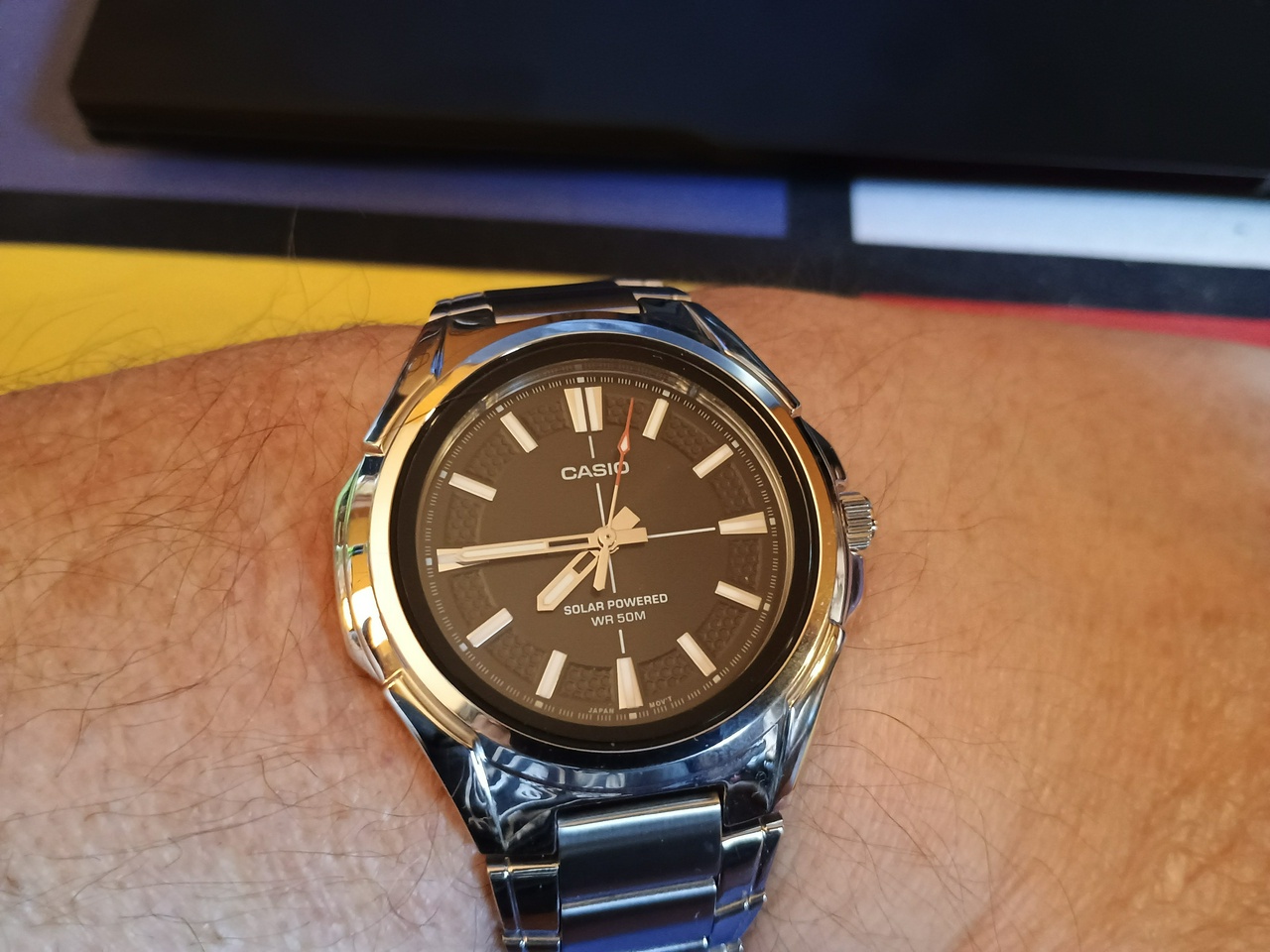
Photo of a Casio MTP-RS100D with a black face on a man's wrist. Photo by Unattributed. License: Creative Commons 4.0: BY-NC-SA. Photo of a Casio MTP-RS100D with a black face on a man's wrist. Photo by Unattributed. License: Creative Commons 4.0: BY-NC-SA.

One of my Casio MTP-RS100D watches. This is the black face version. There are four other variants.

While I was learning about other watches, my Casio collection started growing, and I came to a couple of fascinating models. The first was the MTP-RS100D. These are simple three hand watches, but they have a few interesting features. The first is watch face. It's completely unique, not imitating any other watches that I had (or have) seen. Second, it's a solar watch, with the ability to store enough energy to operate for four months between charges. (Typical automatic watches can only store enough energy for 40–70 hours of operation without winding.) And the price was under $100. Admittedly there are some not-so-positive aspects to the watch. For example the bracelet isn't all that high quality, and replacing it is difficult due to the way it integrates into the case. Also, I wish it had a date complication (or even more a day and date complication), but some see the lack of this kind of complication to be a positive. The clasp isn't all that good either. And it has a mineral glass crystal instead of sapphire. But, for under $100 it is above and beyond the value of many $500 and even $1000 watches.
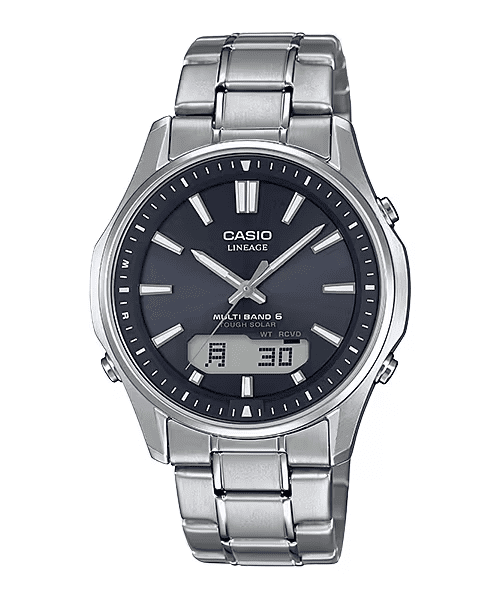
Casio Lineage LCW-M100TS. The watch the stunned me. Casio Lineage LCW-M100TS. The watch the stunned me.

Then came the absolute bombshell watch for me: the Casio Lineage LCW-M100TS. This is a hybrid “Ana-Digi” watch, meaning that it's face is that of an analog watch, but it incorporates a digital display. Honestly, I initially didn't like a lot of the “Ana-Digi” watches until I saw this one. This watch has a similar look to the MTP-RS100D, but the dial features a simple sunburst pattern, and the integrated LCD panel. But, that's not the impressive part of this watch...it's all the features that it has: world time, timer, full auto-calendar (up to 2099), backlight, solar (with an energy saving feature that allows it to operate for up to 22 months on a single charge), stopwatch, alarm(s), atomic clock synchronizing, automatic timezone adjustment. And then there is the case and bracelet: all titanium, with a sapphire crystal. The price? Depending on the variant $150-$200 USD. Lineage watches are a “JDM” (Japanese Domestic Market) line of watches. So, getting them imported and still being a fraction of the price of similar watches from Seiko, Citizen, and others is quite remarkable. Not to mention that they are fraction of the price of many Swiss and European watches, and are just generally a more solid value. (There are some other things that I will discuss in another article that put them above literally any other mechanical watch.)

Of course, these are not smartwatches. They don't have health tracking sensors, and they don't integrate with your phone for notifications, or media control, or anything like that. However, from my perspective it's important to actually place smartwatches in the context to the broader watch market, as will become clear throughout the remainder of this article.

Now, there is a Casio-shaped elephant that I am not covering here: the G-Shock line. They are really forerunner to the smartwatch, having many of the features that the Pebble is focused on bringing out. And, in fact, they also have models that incorporate some of the important features of the above watches. But, their Ana-Digi watches don't look as nice as the Lineage to me, and I personally didn't want to wear a digital watch all the time...so I haven't gone too far into them yet (although I do have an GBD-200).

Next we have to talk about the Apple-shaped elephant of the smartwatch world: the Apple Watch.

The Apple Watch Is More Impressive Than You Know

Deutsches-uhrenmuseum, CC BY-SA 4.0 https://creativecommons.org/licenses/by-sa/4.0, via Wikimedia Commons Deutsches-uhrenmuseum, CC BY-SA 4.0, via Wikimedia Commons

The disruption to watchmaking caused by the Apple Watch was not a completely new event in the annals of watchmaking. The first such event was the Christmas Surprise of 1969 when Seiko released the Astron: the first mass market quartz watch. The Astron achieved a greater accuracy than the majority of mechanical watches, and was able to run for up to a year on a single battery. Something no mechanical watch could achieve.

This event sent shock waves through the Swiss and European watchmaking industries, but many watchmakers seemingly ignored the importance of the watch. Within a few years the mechanical watches had lost a large portion of their market share as quartz watches became easier to manufacture, were more readily available to the public, and were much less expensive than mechanical watches.

This caused a large scale reorganization, consolidation and refocusing of the mechanical watchmaking industry. Instead of being the ubiquitous objects that many people needed, they became niche objects and luxury items.
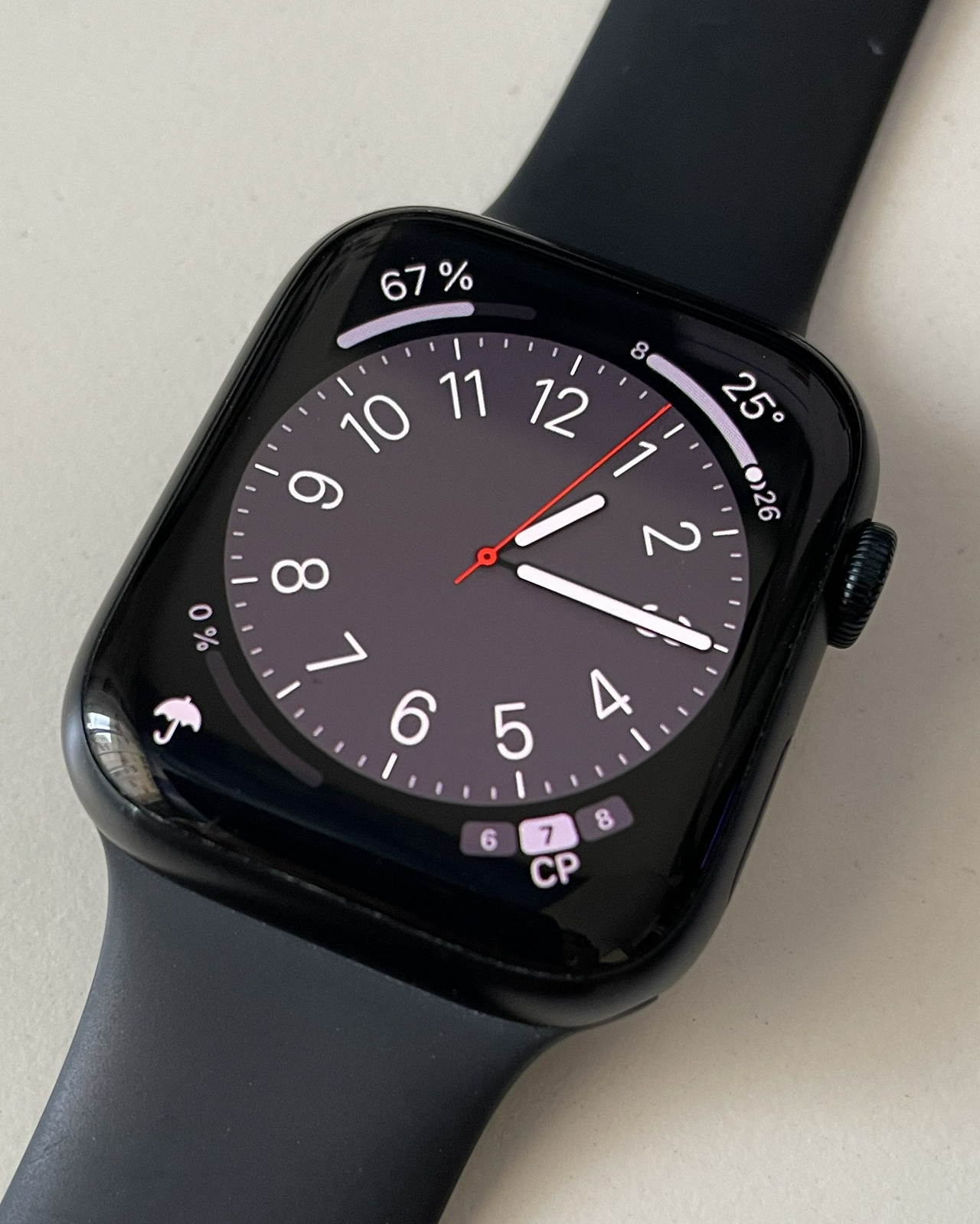
Apple Watch photo by Terminator216, CC BY-SA 4.0 https://creativecommons.org/licenses/by-sa/4.0, via Wikimedia Commons Apple Watch photo by Terminator216, CC BY-SA 4.0, via Wikimedia Commons

Then just 45 years after the release of the Astron, Apple released the first Apple Watch. In a few short years, the Apple Watch's market share grew to an astonishing level, taking the majority share of quartz watch market (both analog and digital watches), as well as many of the health tracking devices, and further eroding a portion of the luxury mechanical watchmaking industry. (Apple managed to out-sell all Swiss watchmakers combined in 2020.)

Many watchmakers and watch collectors and aficionados dismissed the Apple Watch as not being a real or serious watch. There are several reasons for this: (a) the device doesn't “feel” like a watch, (b) they don't see its primary use is as a timekeeping device, instead focusing on other functions like health monitoring, media control, and notification display, as well as a myriad of other applications the watches can run, and © the fact that it is tethered to a cell phone to provide much of this functionality.

And while certainly all of this is true, it is a way to dodge the fact that Apple went to great lengths to make the Apple Watch a timekeeping piece that exceeds COSC certification standards, and most of the quartz watches on the market. In an article in Mashable from 2015 (Here's how Apple synchronized all your Apple Watches), Apple's VP of Technology, Kevin Lynch, outlined a number of the features of the Apple Watch that are fairly impressive.

First, the Apple Watch does actually have a self-contained quartz movement. Next, in order to maintain that accuracy they curated their own global network of Stratum One NTP (Network Time Protocol) servers (these servers are only a single step away from an atomic clock). Third they implemented a temperature control crystal oscillator to compensate for changes in temperature. The end result is the Apple Watch is accurate within 50 milliseconds (0.05 seconds) of Universal Standard Time. While this might not sound impressive consider that typical quartz watches from Casio are accurate to approximately +/– 20 seconds per month (which is around 0.5 seconds a day), and COSC Certified mechanical watches average −4/+6 seconds per day. (Ed. Note: the article doesn't mention the quartz movement. However, the crystal oscillator temperature control is only necessary if there is a quartz movement.)

Certainly, there are quartz watches that rival the Apple Watch in terms of accuracy. In fact, there are some watches that actually have their own miniaturized atomic clocks built into them, which are considered to be the most accurate in the world, but they are also exceptionally expensive (the Hoptrof No. 16 was $24,000 in 2015).

Now with all this context, lets talk about the Pebble and some of the issues that it faces.

Reviving The Pebble Smartwatch

The Pebble smartwatch was definitely ahead of it's time in 2013 when it came to market (after doing a Kickstarter fundraising campaign in 2012). It actually hit the market two years before the Apple Watch, so it's only real competition were some of the wearable devices from the likes of IBM, Sony Ericson, and Fossil (amongst other early attempts at bringing smartwatches to market in the 1990s and 2000s).

Today, however, I think it is best to take a long look at both the Smartwatch and Wristwatch markets to identify the key items that a revived Pebble should try to achieve. Here is the list of things that I would want rePebble to consider as they work on reviving their Smartwatch:

  • Power usage / recharging
  • Privacy & App Issues
  • Standalone usage Vs. Tethering
  • Timekeeping Accuracy
  • There is still a Pebble

Let's take a look at each of these topics.

There Is Still a Pebble Smartwatch

I hadn't mentioned this so far, but while researching and gathering materials for writing this piece, I came across a website for a company that still is selling watches under the Pebble brand. This doesn't appear to some fly-by-night operation either. My guess would be that through the long process of properties being split up and sold off this company somehow ended up with the right to use the Pebble name.

The company appears to be in Bengaluru, India. I don't personally know the status of India when it comes to copyright, trademarks, or other so-called “intellectual property” issues, it would seem to me that it would likely be best to avoid a situation where there could be a conflict. Don't really want to see lawyers having to get involved in some form of international trademark legal fight before you've even gotten your product to market.

Power Usage

The current state of cellphone and smartwatch power usage is absolute insanity to me. The fact that most of these devices need to be charged via a cable or “wireless” connection is utterly ridiculous. Solar wristwatches have existed since 1972 (The History of Solar Powered Watches). Over the past 50 years, the advancements in solar technology by Seiko, Casio and especially Citizen have made it to the point where there's no need to make adjustments to many of these watches for months at a time.

Now, I know you might be thinking “but the power requirements of a smartwatch are different from a wristwatch”, and I would partially agree with that. However, when we look at hybrid watches they have a fairly intense power usage to actually run a motor to move a second hand, which could deplete the battery. So, look at watches like the Casio Lineage watch mentioned above: it will sleep at night in order to preserve the power it would use to run the motor... But it still keeps the other internal functions operational so it is always in sync.

The advancements in microprocessor manufacturing (getting down to 4nm process nodes) along with the advancements SoC technology should enable the Pebble to go a lot further than it has in the past.

The lowered power consumption of embedded processors and SoC's, along with improvements in solar technology and energy storage should allow creating a device that can recharge itself from available light on a daily basis. And, given that most customers will likely wear these watches daily, there shouldn't be an issue.

I do understand that there will be technical challenges to this decision. But even those challenges likely have solutions. We have sleep modes, connections can be closed when not in use, etc. I don't think those challenges should prevent creating a smartwatch that is solar-powered.

Privacy Issues

As I noted above, one of the biggest issues I had with many of the Smartwatches on the market today were the fitness tracking applications. The amount of information that the user is having to give up in order to track their health information is insane.

If there is going to be a specific app for the new Pebble, please make it open source. Also, please contribute to the existing open source applications that are available (one of the best seems to be Gadgetbridge, which I'm guessing you are aware of since it has Pebble support).

I think the biggest thing to do in this area is: develop the new Pebble as a privacy respecting application. Do not place your customers in the position of having a recommended application that will sell their information. This is something that is worth emphasizing in announcements regarding the device. And, reaching out to privacy respecting open source applications as you work through the development process will help generate more good will.

Standalone Usage

While one of the more appealing aspects to smartwatch customers is the ability to tether their watch to their phone to enable some extended functionality, the new Pebble should make it a priority to be a “watch” at it's core before being “smart”.

Let me explain my thought process here. The wristwatch market has created devices that have stood the test of time, quite literally. There are watches from the 1500s that are still in existence today (although whether they are functional, or accurate is another matter). We regularly see watches that are 50–100 years old that are still functioning.

Today many smartwatches (and cellphones) are seen as disposable devices. Every few years people run out to buy the latest Samsung Galaxy watch or Apple Watch because of “cool new feature X”. And many of the old devices end up in landfills.

But, this doesn't need to be the case. Yes, adding new features and releasing new devices is part of the business cycle. But committing to a longer lifespan is something to aspire to.

There are two ways to do this: (1) develop the firmware and software in a manner that allows for older devices to be updated, and (2) design the hardware and software in a manner that it can have minimal functionality past it's EOL as a smart device.

In other words: focus on the watch functionality. Even when the device cannot support being tethered to a phone anymore, let it exist as a top-quality wristwatch. Have it use GPS and Atomic Clock radio signals to keep time in sync. Have built in timers, alarms, stop watch, perpetual calendar, etc. features.

I have this extreme scenario in the back of my head when it comes to wristwatches: how useful is a watch going to be if the national infrastructure were to disappear? What if I can't get batteries for my watches? What if there is no one to service a mechanical movement? How long could my watch last and be useful?

This is where I think design choices are important. Solar charging allows the use of a watch for probably a good ten to twenty years without batteries. Making a digital quartz movement removes the need for maintenance of the movement. Being able to sync to an atomic clock via radio signal (not over the internet) means I should have accuracy for a while (the military radios aren't likely to go offline immediately).

Even if that kind of scenario doesn't happen, a smartwatch that can function without a phone is still useful. It can be passed down to family members, especially children who don't need to have all the smartwatch functionality.

This is the kind of thought and design that will make for a device that will be able to last for a long time.

Timekeeping Accuracy

I mentioned this above, and these two points are actually interconnected. A smartwatch should be able to keep more accurate time than a cellphone. This should be somewhat obvious: runners and joggers will want to have accurate times for their activities. Anyone that needs to use a stopwatch will want it to be as accurate as possible.

It takes more than just a simple quartz movement to enable this functionality. Syncing the time to an atomic clock, accounting for drift and skew, using temperature, altitude, air pressure and other sensors to compensate for external environmental issues that can affect the accuracy of the movement / calibre is important.

As I mentioned above, Apple spent a lot of time developing a number of these items for their Watch. While it may (or may not) be as impressive ten years after the first Apple Watch hit the shelves, the fact is that timekeeping was a core focus when developing their watch. The new Pebble should take the same approach, leveraging as much watchmaking knowledge and technology as possible.

Conclusion

Thank you if you have read this far. I know that it was a lot to take in, and there were a lot of thoughts that I have put on the page in the hopes that it will help to guide the developers of the new Pebble. But, I think this article can go a lot further with how we think about both watches and connected devices.

The fact is that a lot of watches have a very long life cycle. Yes, they do need maintenance – whether it's the changing of a battery in a quartz watch, or re-calibration / maintenance of a mechanical movement.

It's my hope, however, that this article shows anyone who is interested in watches that there is a different way to go. There is a way to have modern features and longevity, instead of treating smartwatches as disposable tech. The concept that a watch should be treated in the same manner as a piece of a fast-fashion clothing is disturbing. We can do better. We need to do better.

The new Pebble offers that opportunity.


Categories: #Technology, #Features, #Opinion, #Editorial Tags: #atomic, #atomicclock, #business, #calendar, #calibre, #device, #devices, #digital, #movement, #pebble, #quartz, #repebble, #smartwatch, #smartwatches, #solar, #stopwatch, #time, #wristwatch

Child launching a candle balloon

Introduction

I don't think I've really spent any time in the past writing personal “year in review” articles on my sites. Yes, I might have done year-end looks at things like the best or most popular reviews I had written, or written about things that I felt were overlooked. But, those were on sites that had specific themes so it was appropriate, at least to the way I felt at the time.

However, a generalized look back is not something that I tend to do. But I think given the nature of Unattributed, it seems more important now. However, I don't want it to just be a listing of a bunch of news stories, or a list of things that happened during the year. I am choosing instead to write about things that felt more personal to me, for whatever reason.

Remembrances

I think the place to start is with those who are no longer with us. In particle a couple of musicians I don't feel were honored as much in life or death as they should have been.

The first was the passing of Klaus Schulze, the electronic musician who was one of the founders of what would become known as the Berlin School of electronic music. He was a pioneer, starting before synthesizers and electronic instruments were even widely available to musicians, and even if they had been, they were the subject of much ridicule amongst “serious” musicians. He got his start as the drummer in one of the early lineups of Tangerine Dream, but parted ways with them when Edgar Froese rejected the idea of introducing tape loops into their sound (which Schulze had advocated). While the two parted ways, they remained friends, and Schulze would even joke about their friendship at times. For example, Schulze once said in an interview that he and Froese had conspired to divide their world conquests by Froese touring in the West, while Schulze toured mostly in the East.

Some of the recordings that have meant the most to over the years are Audentity, Beyond Recall, Timewind and Trancefer. These were all recordings that I found at just the right times in my life where I needed the calming, minimalist effect of Klaus's compositions. In addition to these recordings I've loved The Dresden Performance, and The Dome Event since I first heard them. In reviewing his releases to write a larger piece that remains incomplete (and will likely be completely re-written before it is released) I found two more that have taken on a special place in my listening, those are In Blue and Eternal – The 70th Birthday Edition.

Anyone who loves electronic music should really listen to Klaus Schulze if they aren't already familiar with his work. A career that spanned over six decades, and has been the inspired many contemporary electronic artists deserves to be elevated by all listeners.

Another musician, and an electronic musician to boot, that passed in 2022 was Vangelis. He was probably most known for the soundtracks to Blade Runner and Chariots of Fire. However, I knew of his works since my college days, especially Albedo 0.39, China, and Opera Sauvage. But, that was just the beginning for me with his works, because I later found that he had collaborated with Jon Anderson of Yes, and had produced several albums under the name Jon and Vangelis, a partnership which saw the unlikely duo produce a hit song: “I'll Find My Way Home”, and would take a rather amusing turn as Vangelis attempted to become a member of Yes.

In picking up some of his later releases, I have found an album called The City to be absolutely spellbinding. It is such a cinematic work that I initially mistook it for a movie soundtrack. And, I really wanted to see that movie, so much so that I went looking for it on IMDB, only to later find out that The City was actually a standalone work by Vangelis.

And the final one that I wanted to mention, mostly because it wouldn't get a notice in the United States, was the passing of English actor and comedian Peter Bowles. For those who watched a lot of British TV in the 80s and 90s Bowles would be known for his roles in shows like To The Manner Born, I, Claudius, Rumpole of The Bailey, and Executive Stress. Surprisingly (to me at least) the only reason I found out of this actors passing is because of an appearance he made on The Sarah Jane Adventures, which brought him into the Doctor Who universe.

While there were many others who passed in 2022 (like Barbara Walters, Pele, Irene Cara, Christine McVie, Taylor Hawkins and Kirstie Alley, just to name a few), I feel that the above are ones that will not get nearly the attention that they should, and are worth memorializing.

My Personal Goals

So, how did I do on my goals for this past year? Honestly, not all that well. Even the smaller things that I should have been able to accomplish, like reading a reasonable number of books, or writing a lot in a journal. It just didn't happen. Then there are the bigger things: like overhauling and re-modelling this house, or getting back to the gym and working on my health in general.

Now, I won't say that all of this was an absolute failure. For example, I did actually write more in my journal last year than I had in the previous four years combined. And I can say, that there were other things that I managed to accomplish — things that I won't really talk about here. However, they were things that were related to the estates of my parents, and now that they are settled all of that can be placed in my past.

And, I realized that there is something else going on with me. There is something keeping me from getting to the bigger projects that I want, and even need, to tackle. So, this is something that I am seeking help with in the new year (I actually started a couple of months back — but I'll keep that as a goal for this year).

One of the things that I think I have recently realized is that I abandoned something that I need. I need something to keep my life in a sense of structure. I need to have something that will keep me going from day to day, keep me motivated and focused. That's what I have lost, and something that I need to find again.

Okay, enough of the personal dribble from me.

What Did I Do?

So, what things did I accomplish? Well, I managed to get most of these websites reorganized — except for a couple of them. This means that I was able to launch this site and I wrote some articles on it. Not as much as I want to write, but I did manage to publish a few pieces.

And, I got lost in messing with mechanical keyboards, and launched a site for that as well. However, I drifted away from mechanical keyboards as another of my older hobbies / interests took over: music and stereo equipment. I started writing a bit about that on here, and it's a topic that I will be returning to this year.

And, keep in mind, that most of this happened while I had other things going on in the background — so I don't blame myself for getting too distracted. :)

News Stories That Capture My Attention

So this is the last thing that I wanted to write about in here: a few of the new stories / issues that have managed to grab my attention.

The most obvious only is Elon Musk's Acquisition of Twitter, and the Ensuing Disaster. I don't know why, but there is something about a train wreck that just can grab your attention. In this case, it was the combination of not only the hilarity of some of Elon's truly disastrous decisions, but the positive effect that it has had for Mastodon specifically, and the Fediverse in general.

The January 6th Committee Hearings. I watched all of them as they were broadcast. And it was a roller-coaster. The Committee managed to pull together things that were surprising and even shocking. For example, getting documentary footage of one of the militant groups actively canvassing the capitol before the rally had even started. Seeing Cassidy Hutchinson's testimony live on camera for citizens of this country to have a real inside look at how the White House and the staff were reacting to the events as they unfolded. Having several poll workers who had been threatened for no legitimate reason to testify. Getting several State representatives to testify to the pressure campaign that Donald Trump and his agents put on them to over-turn the election results in his favor. And so much more information.

I haven't read the final report yet. That's on my list for reading soon (Like probably just after I finish the current book I started.)

Oh, and we can't forget about the further Absurdities of Donald Trump this year. First for getting raided because he took classified documents from the White House when he left. Then he started a court battle to slow down the investigation into those documents. Then, when things started heating up with the January 6th Committee, he decided it was time to announce that he was running for office again — seemingly betting that would get the Justice Department and Federal Investigators to back off. And, if all of that were absurd enough he announced his own line of NFTs...which leads us into....

The Collapse of Cryptocurrency including FTX. Boy this wasn't the year for Cryptocurrency. There have been a number of scammers and grifters all over those markets. And, one and another, they kept blowing up and failing over and over. And all of this during one of the biggest down turns in the market. Not to mention the Instability of the Stock Market which has had major effects on the whole economy, not just the United States, but all over the world.

The Resignation of Boris Johnson who was then replaced by Liz Truss as Prime Minister, who then resigned after 45 days in office. And all of this happening during the period of the Death of Queen Elizabeth II. To say that it was a politically tumultuous summer / fall in England would be the understatement of the year.

Oh, and all of this taking place while Russia invaded Ukraine and started a War. Which, despite the loss of life and the sheer tragedy the Ukrainian people are going through, might also be seen as one of the most inspiring stories of the year. At the outset of the conflict no one believed that Ukraine could sustain a fight with Russia. But, Ukraine has proven time and time again how resilient they are. Not just holding back Russian troops, but actually getting them to withdraw from several positions. And, even providing a bit of humor at times, like when a small coastal island off the Ukraine mainland told a Russian Warship to “Go fuck yourself” over an open radio broadcast.

The End...of 2022

And that's where I am going to leave it for now. Overall it seems like 2022 wasn't all that great of a year. But there are things, like the resilience of Ukraine that should give us all hope for 2023. For me personally, I hope that I have hit a turning point with the realization that I needed to start doing something different. That I needed to get some kind of help. And, hopefully, now that all the things that kept popping up and disrupting my life are out of the way I can move forward.

Categories: #Features, #Opinion, #Editorial Tags: #2022, #mastodon, #news, #remmbrance #inmemoriam

Originally Published: 2022-12-17 Mastodons in a Winter Landscape

Introduction

[NOTE: Quite a few things in this article have changed since it was originally published. This article is being left in its original form mostly for the history it represents.]

In Part One of this series we looked at the criticism that the signup process is cumbersome. It's a fair criticism, so we looked at the process, and I provided a shortcut for signing up. In this article we turn to the other major criticisms of Mastodon.

Since the beginning of the Twitter Exodus / Migration there have been several sites that attracted attention. Mastodon has possibly been the most impacted by this migration because of its similarity in appearance to Twitter. Of course, with this attention there will be people who are not happy about the differences that exist, and find it appropriate to criticize the platform.

Some of these criticisms are fair, however many of them actually underscore the difference between Twitter and Mastodon. And those differences, are what make Mastodon special, and in many people's opinion special. So, let's talk about these criticisms.

Too Many Instances Makes Mastodon Complicated

No, it really doesn't. Actually, having as many instances as possible is a strength of Mastodon. There are, in fact, several specific strengths that having so many instances brings.

The first strength is that individual instances can focus on building a community around a specific topic, interest, or need. For instance there are instances for writers, artists, members of the LGBTQA+ community, activists, and journalists. By having these instances it makes it easier for people who having things in common to find each other.

And, for some of those communities, it makes it easier for the moderation policies to be adjusted to handle the specific needs of those communities. For example, creating safe-spaces for members of the LGBTQA+ community.

But, there is another strength in this, with multiple instances there is a guarantee that there is no one person calling all the shots. The shape of the network is the work of multiple people who are highly motivated to make the network into something special.

The final benefit is that if you aren't happy with one instance, you aren't tied to it. You can migrate to another instance that has policies that fit you better. And, you can take your followers with you – just download them from your current instance, and upload them to your new instance.

No Single Administrator for The Network

This is something that should be seen as a major benefit given the current state of Twitter. Since there is no single person responsible for the whole network there is a better chance of actually being able to communicate with the person responsible for your instance.

When I was on traditional social media sites, there were many times when it would have been normal to actually have direct contact with someone to address an issue. But the way most of these social media companies are operated, it's only the people with the largest impact on the site that have any ability to work with a representative from the company.

However, Mastodon is different. The administrator for your instance is known to you. You can send them direct messages. They can investigate issues on your behalf. And, many times, if it is warranted the administrator will take action. Why? Because it is in their interest to do so. The Admins of Mastodon want to create the best environment they can for their users.

If the issue involves another instance, the Admin can work with the admin of that other instance. If the issue is much bigger in scope (such as an instance that is posting illegal materials, or whatever) that can be addressed at the network level — the administrators have tools for handling these things.

The fact is, by having multiple administrators, it's more likely that issues get addressed and resolved, instead of festering is some support queue for months on end.

There Are No Quote Posts / Toots

[Note: This has changed. Most platforms, including Mastodon, now offer Quote Posts.]

That is correct. There aren't quote posts. Why? Because this feature on Twitter is widely abused, and is the antithesis of what Mastodon has built for a social environment.

Quote Tweets have frequently been used to offer snarky or negative commentary on a person's post without contributing to the conversation. Instead, this often leads to dog piling, brigading and ratio'ing of the original post. This is the kind of negative behavior that is not being encouraged on Mastodon.

Instead, if you have a counter-point or argument, reply to the original post. Do it respectfully. Through directly exchanging opinions and perspectives all parties involved in the post can learn things.

Honestly, you won't miss quote-posts after a little bit.

Content Warnings Are Stupid

Admittedly, Content Warnings are controversial. There are some people that feel you should never have to use them, and others that feel they should be used more frequently than they are. Personally, I find there are times to use them, and times that they probably don't need to be used.

So, how do I approach this? There are two times that I will use them:

  1. When talking about more sensitive topics, like SA, Self harm, politics, religion, etc. This one is a little bit tricky to know when to use them – but when you participate in these kinds of topics you get a feel for when it is appropriate. Rule of thumb: if something could be a trigger, it's a good idea to use a content warning...

  2. When a post might cause problems for people using assistive technology. One that was pointed out to me recently was posting Wordle results. For people using screen readers it's horrible to hit one of those posts... They have to listen to “colon <emote name> colon” repeated thirty times. It gets worse if you post other similar games along with Wordle (like SquareWord or QuadWord).

So, while Content Warnings aren't the most obvious feature to use – there are times / contexts in which it makes sense to use them.

There's No Verification

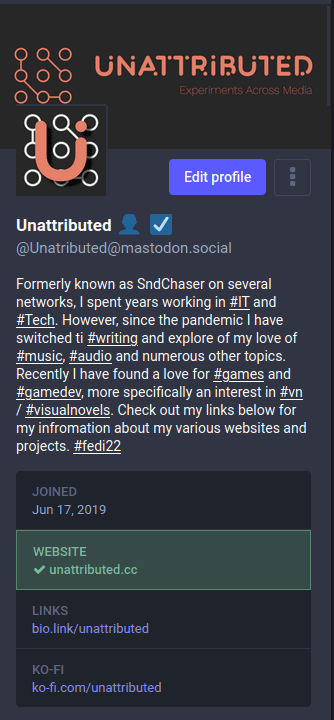
There is no formalized verification. However, there is a way to link to other presences you have on the Internet. For example, my Mastodon profile shows the following:

Screenshot of profile with highlighted website link

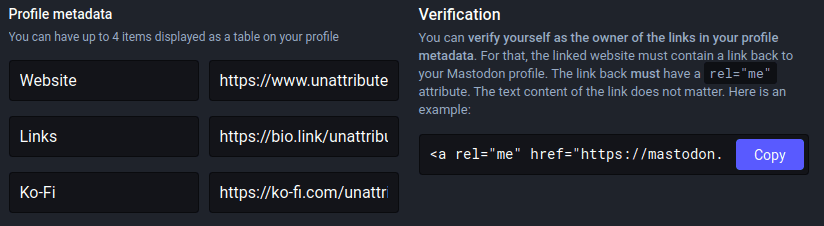
The green highlight is the verification that I have control of this website. This was done by inserting a link into this website's code that links back to my Mastodon profile. How this is done is found in the Settings->Profile for your Mastodon account:

Verification instructions in Settings-&gt;Profile

We are starting to see other services pop that offer verification of this type. For example, tonight I found PressCheck, which provides credentials for journalists that have moved to Mastodon, and provides this same back-link to their profiles.

Inconsistent Moderation Policies

Now let's be clear about something. All the Mastodon instances that are listed on the official Join Mastodon website have agreed to the Mastodon Server Covenant. This is a requirement to be allowed to have an entry in the database.

Beyond the Mastodon Server Covenant, the administrators of each instance are at liberty to implement moderation policies / rules that are the best fit for the community that they want to build. This flexibility is actually powerful and important in the Mastodon network. This allows Administrators to do things like create safe spaces for members of the LGBTQA+ community. It allows administrators to choose whether NSFW content is allowed or disallowed on their instance. More importantly, it allows them to set the policy for how these rules are enforced.

When you go to sign up for an account you are shown the rules for the instance. It's typically a fairly short list that doesn't take long to read. If you don't agree with something in the rules, find a different instance with rules you don't have an issue with.

If you create an account on an instance, only to find you don't like the way it is being run, you are free to migrate to another instance. The Mastodon documentation as a whole section on Moving or Leaving Accounts.

Finding people isn't as easy as other social sites

Is finding someone on Twitter easy when you don't know anyone? Not really. But with Mastodon it really isn't more difficult. There are a few things you can do:

  1. You can use tools like Debirdify or Movetodon to find others who have migrated from Twitter to Mastodon.
  2. Adding “Featured Hashtags” to your profile will help in curating you home timeline to include content that is likely to be of interest to you.
  3. You can follow a hashtag, just like you follow other users. Just search for the hashtag, and above the results will be a little button to follow the hashtag (it looks like the follow user button).

So, there are ways to find people on Mastodon, by actually looking for the content that interests you.

Direct Messages aren’t really direct messages

They are direct messages, but it might not be quite the way you think of direct messages. On Mastodon a direct message is one that is sent between you and the people you list / mention in the message.

Think of it this way... Email allows you to have direct one-on-one communication. But, if you CC or BCC someone, then that person is able to take part in the conversation as well. Mastodon's direct messages work in this same manner.

Direct Messages aren’t private / encrypted

As explained above, Direct Messages are (mostly) as private as you make them. Yes, an administrator could potentially see your private messages, but they generally would not be likely to look at them unless there is a specific need to.

As for messages not being encrypted.... Guess who else doesn't have encrypted DM's? Try Twitter. Encryption of DM's has been a feature they have tried to add several times. However, they have found that the need to have some kind of personal information for generating the keys to encrypt the messages to be a stumbling block.

In general, outside of messaging applications that specifically offer encryption (like Matrix and Telegram), don't expect your Direct Messages are encrypted.

Conclusion

If you have read this far into the article, congratulations! Hopefully you have a better understanding that many of the criticisms of Mastodon aren't really bad things. They are just differences between Mastodon and Social Platform X.

In many cases, the choices that have been made for Mastodon actually make it a more powerful and flexible network. For example, having so many instances and different rules / moderation policies make the communities of that instance stronger and/or safer for the users of that instance. And, having so many Administrators means that you have more access to the person(s) running your instance.

In some cases things are just different, like the way Direct Messages work, the use of Content Warnings, or how you find people to follow and talk with.

None of this is to say that there isn't room for improvement, or other features that can be added to the system. For example, adding encrypted direct messages is a desired feature that is likely to be addressed by the developers in the future.

One of the exciting things about being part of the Mastodon network is that you can have some influence in its direction. The developers are aware of things that are talked about / requested. And they look for ways to add features that satisfy the needs of as many users as possible.

In the next part of this series we'll try to get you up to speed on using Mastodon. We'll offer a series of etiquette examples for Mastodon (such as the one I touch on here regarding the use of Content Warnings), and then move into some of the power-user tips (such as following hashtags).


Categories: #Technology #Features Tags: #mastodon #socialmedia #socialnetwork #twitter #twitterexodus #twittermigration

Originally Published: 2022-12-16 Mastodon Drawing

Introduction

With the recent upheaval at Twitter many people have decided that it's time to find a new community. While numerous sites have grabbed people's attention including Post News, Hive, Tumblr, etc. My choice is: Mastodon. However, as is always the case with something that is new, there are questions and concerns that people have with a new community.

And, that is expected. Not all social networks are designed the same way, they each have their own flavor. While Mastodon bears a similar look to Twitter in some respects, there are quite a few things that are very different about it. These differences range from how you sign up, to how you find and interact with others, to how you (and the moderators) deal with bad behavior.

So, what are the best ways to get on to Mastodon, and how can you make it into a meaningful experience for you? That's one of the topics we'll explore in this series of articles. The other topic is: dispelling some of the myths that have arisen with the rise in popularity of Mastodon.

Migrating To Mastodon Issues

The most common criticism of Mastodon is that it is difficult to get started. This stems from the fact that some people find the sign-up process to be difficult. The irony is that the current sign-up process was intended to accomplish a couple of goals:

  1. It was designed to make it easier for new users to find groups of people that share common interests.
  2. It was designed to make the distribution of users, and therefore the load / usage of the instances more even.

However, the criticism of this system is not without merit. Sites like Twitter, Facebook, TikTok have a simple signup process because they are a single, monolithic service run by a single entity (typically a business). Mastodon isn't a single entity, it is a collective of entities spread throughout the world that chose to interoperate in the Mastodon Federation.

So, let's take a look at starting a Mastodon account and getting started.

And, if you find that the process is getting a bit too involved for you, scroll down to the section A Faster Way.

Signing Up For Mastodon

There are two ways to sign up for Mastodon: (1) via the official Mastodon App on Android or iPhone, or (2) via the Join Mastodon website. The second method will apply to people using third party apps (like Tusky, Tooot, Fedilab on Android, and Tootle, Metatext, Tooot on iPhone).

Using the Official Mastodon App

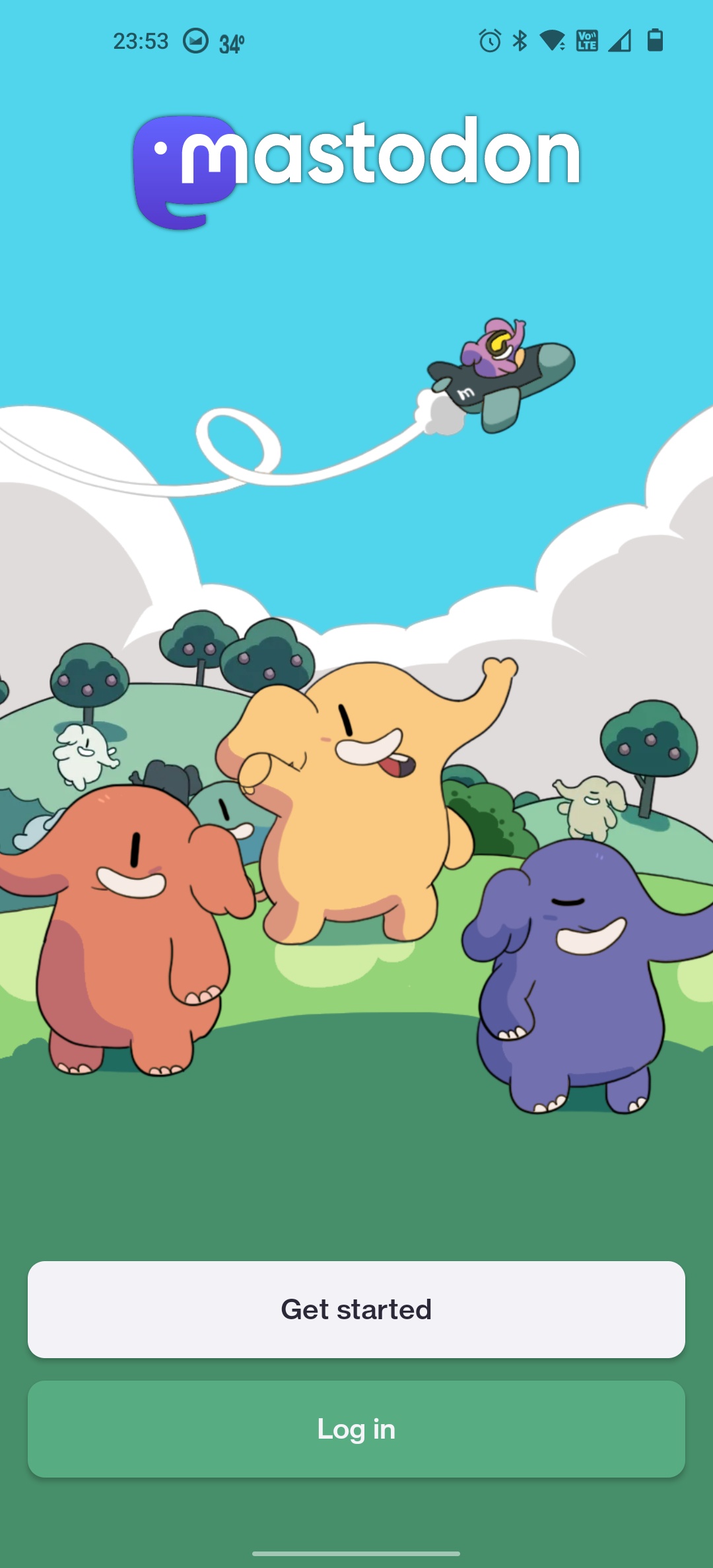
Mastodon Mobile App

Signing up using the Official Mastodon App is less complicated than it has been portrayed as. The biggest confusion tends to come from the need to select an instance.

The start screen (see image 1) for the application offers two options for you at the bottom of it's screen: “Get Started” and “Log In”.

Log in is for users that have already created an account on Mastodon. (It is also used if you decide to change the server that you are logging into... More about that later in the article.)

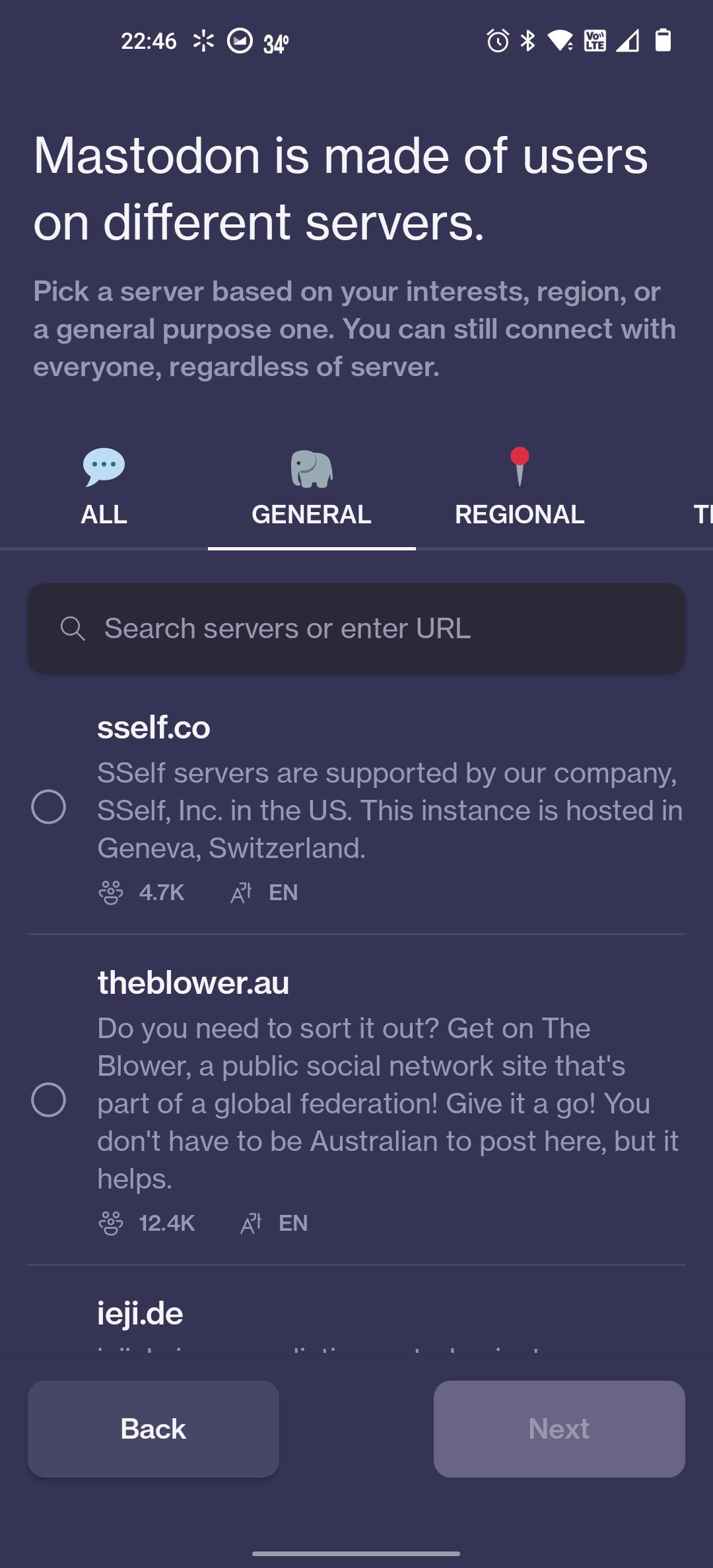
The Get Started option is the one that you will want to select as a new user to Mastodon. Once you have selected the Get Started button, you will be presented with a new screen (see Image 2). This is the instance selection screen:

Image 2: This is the "select an instance" page.

The easiest way to navigate this screen is to select “General” from the options, and then select any server that sounds good to you based on the description. The one consideration that might be a determining factor for you is language. The majority of servers are English, however, there are some for languages like Gaelic, Japanese and that rarest and strangest language: Australian. (I'm just kidding...)

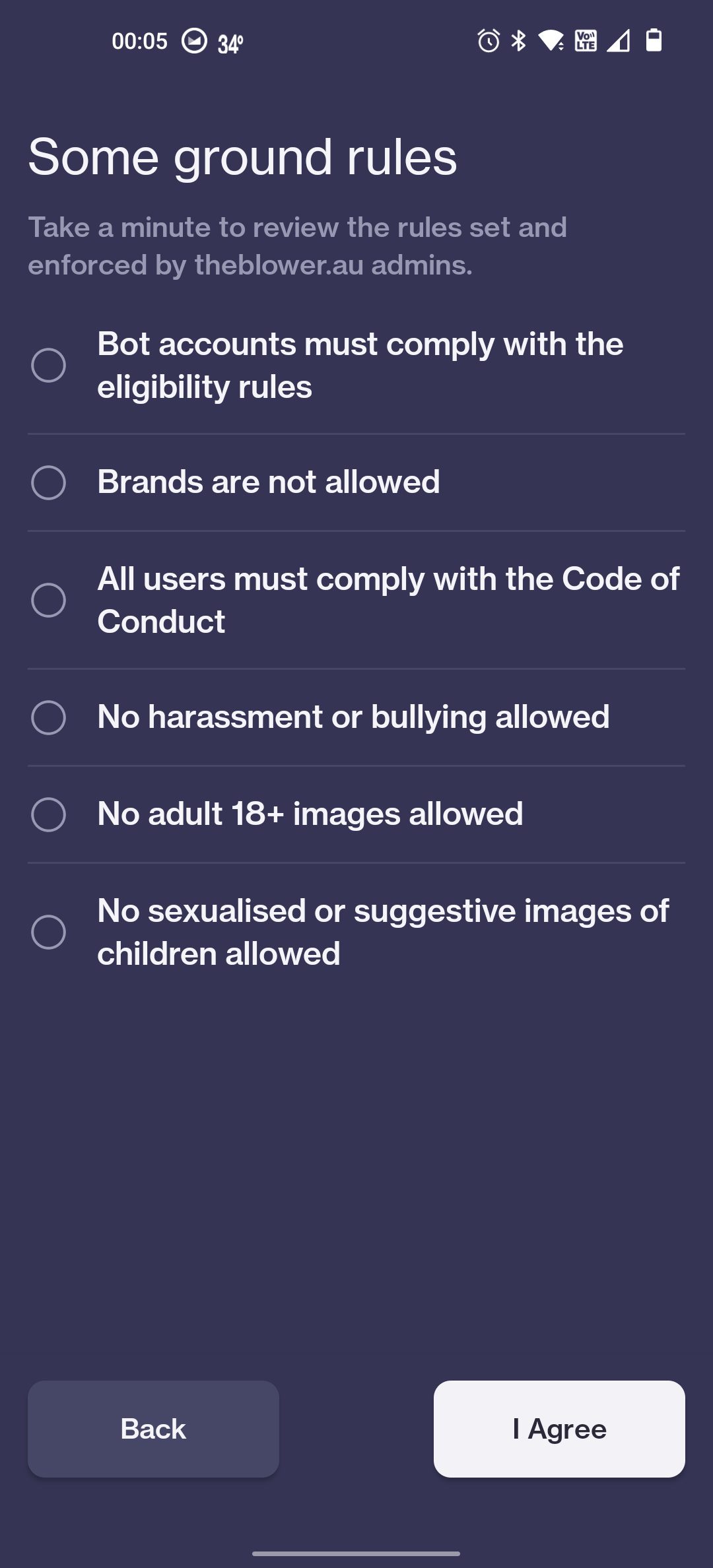
Once you selected an instance, select the Next button. This will bring you to the following screen (see Image 3):

Image 3: Rules for the Instance You Have Selected

Take a moment to review the rules of the instance you have selected. If you agree with them, Great! Click the I Agree button to move forward. On the other hand, if there is something in the rules that you don't agree with, click the Back button to select a different instance.

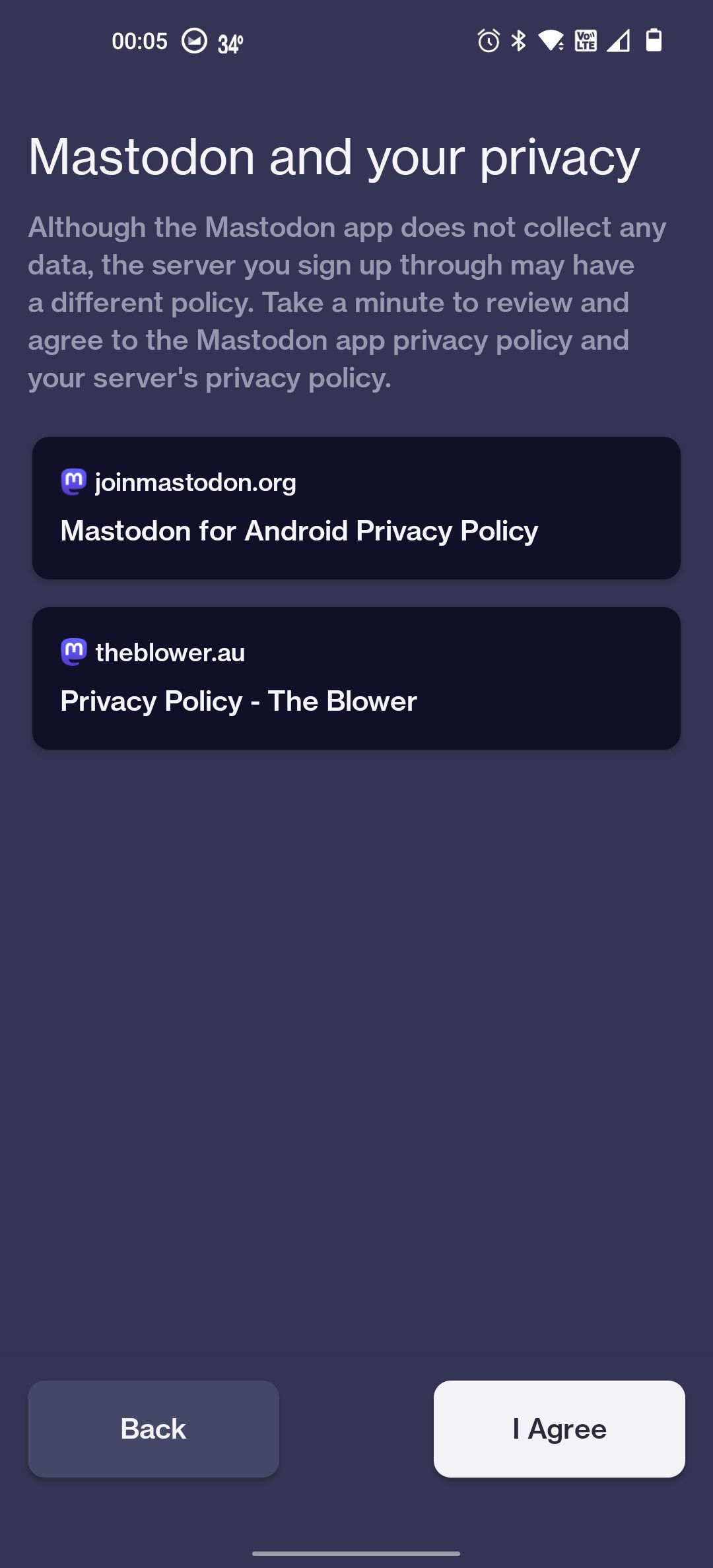
Once of you have agreed to the rules for an instance, you are presented with the following screen (see Image 4):

Image 4: The Privacy Policies

This screen presents you with the opportunity to read the Privacy Policies for both Mastodon App and the instance you have selected. I would recommend reading these, although I know many people don't since they are typically full of all sorts of legalese and jargon. When you are ready, click the I Agree button.

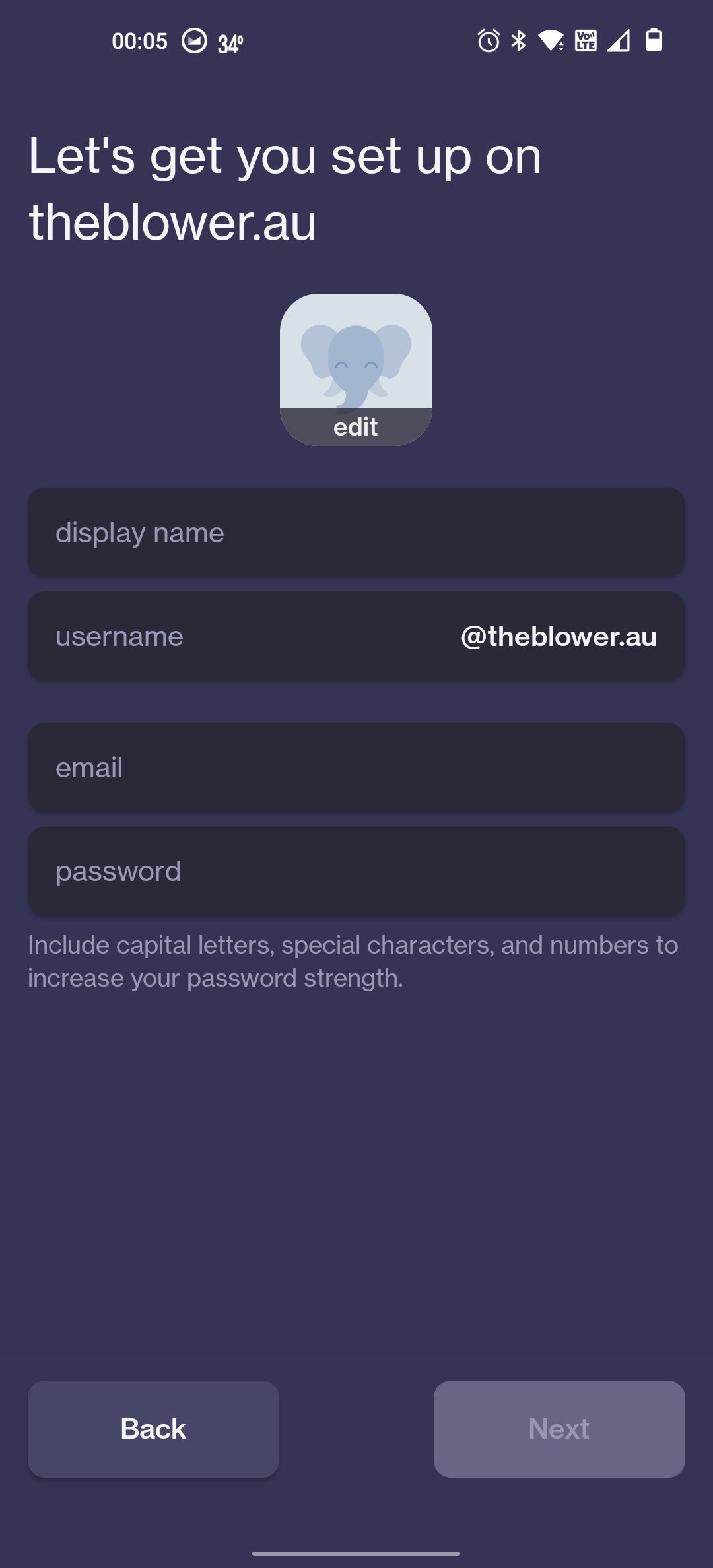
And, you are taken to the final screen (see Image 5) – the account creation screen:

Image 5: Account Creation Screen

This will hopefully look a little more familiar. You fill in the form, select an avatar, and click the Next button to complete the signup on the instance you have selected. From this point on you will be on Mastodon and can start looking around, finding people to follow, etc.

Using The Join Mastodon Website

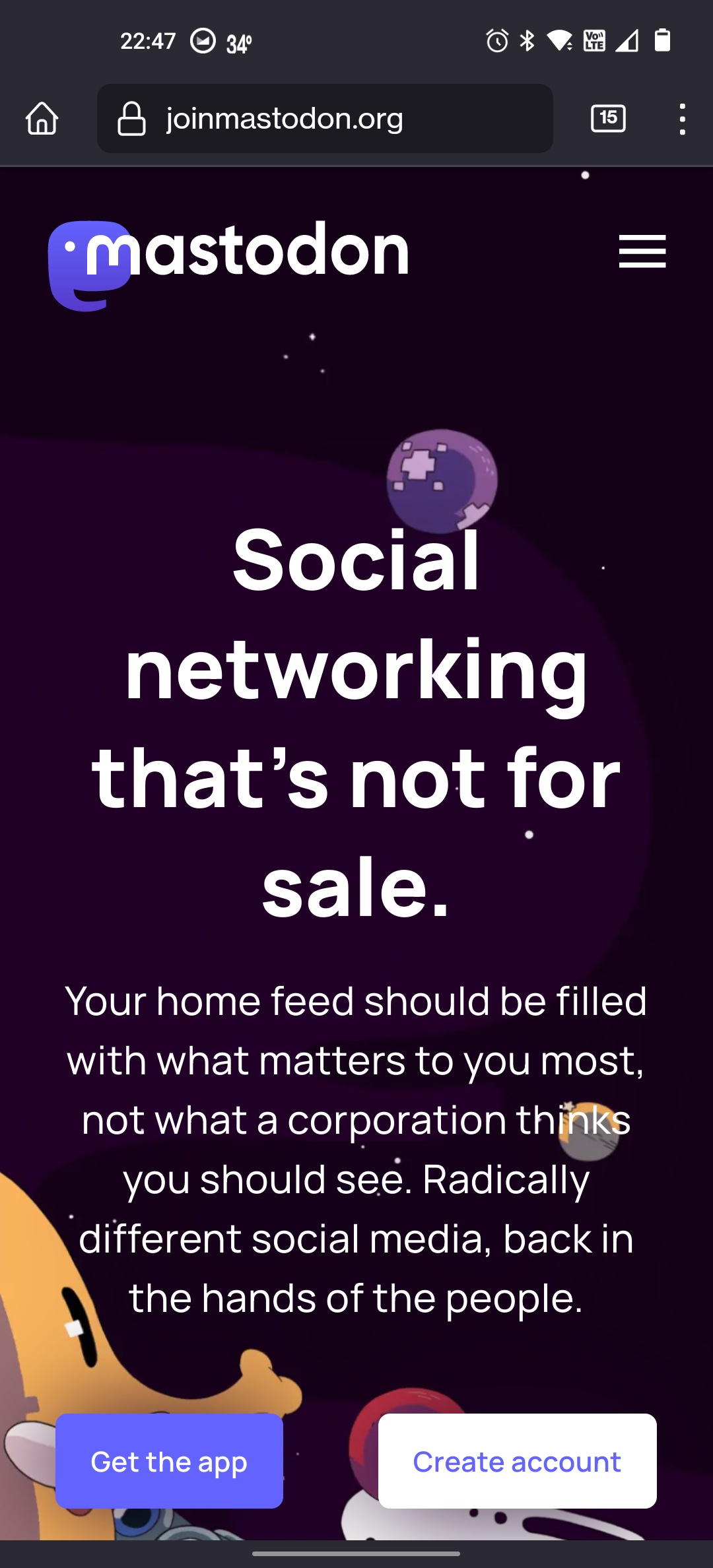
Using the Join Mastodon website is a similar experience to using the official Mastodon App. When you go to the website you will see the following page (see Image 6):

Image 6: The Join Mastodon Web Page

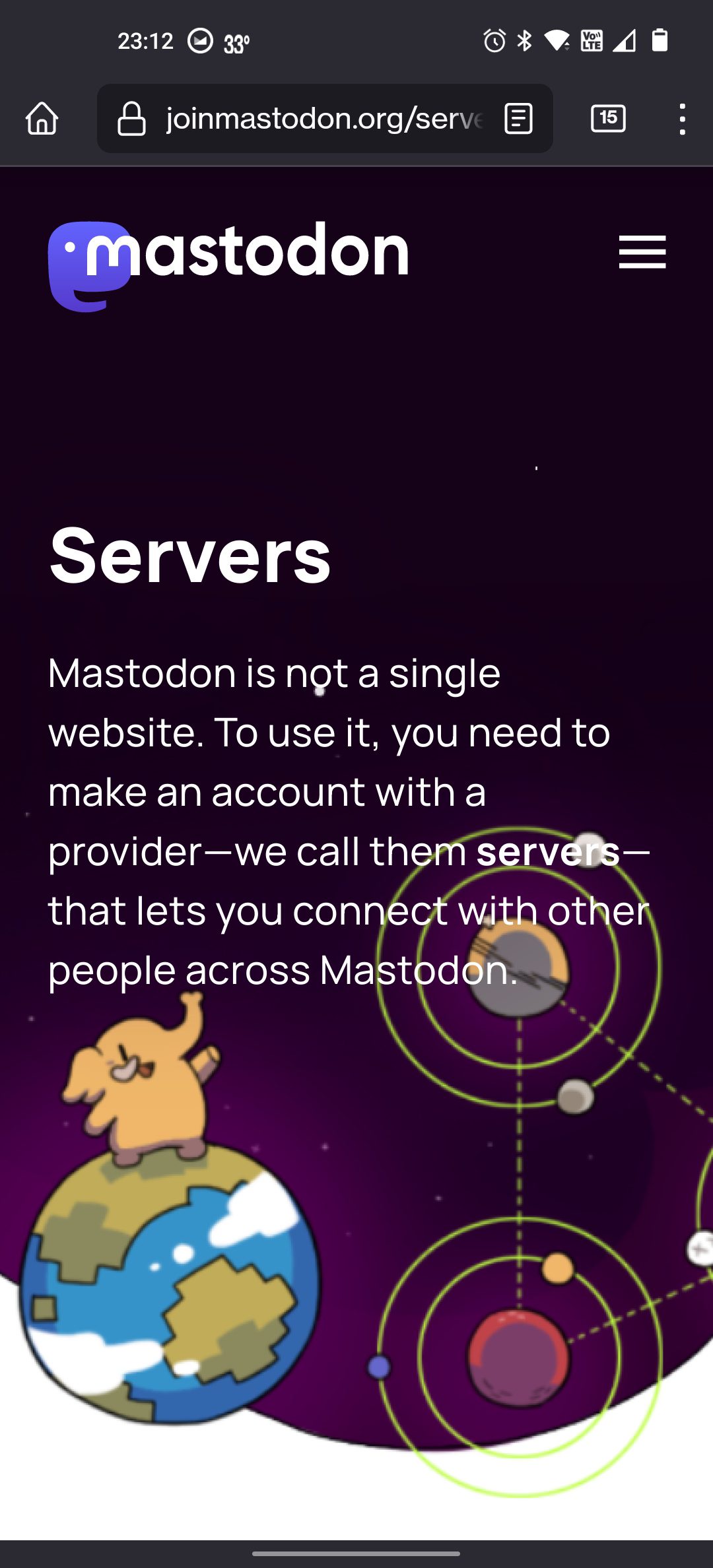
To get started click the Create Account button, and you will be taken to the following screen (see Image 7):

Image 7: The Instance Selection Page

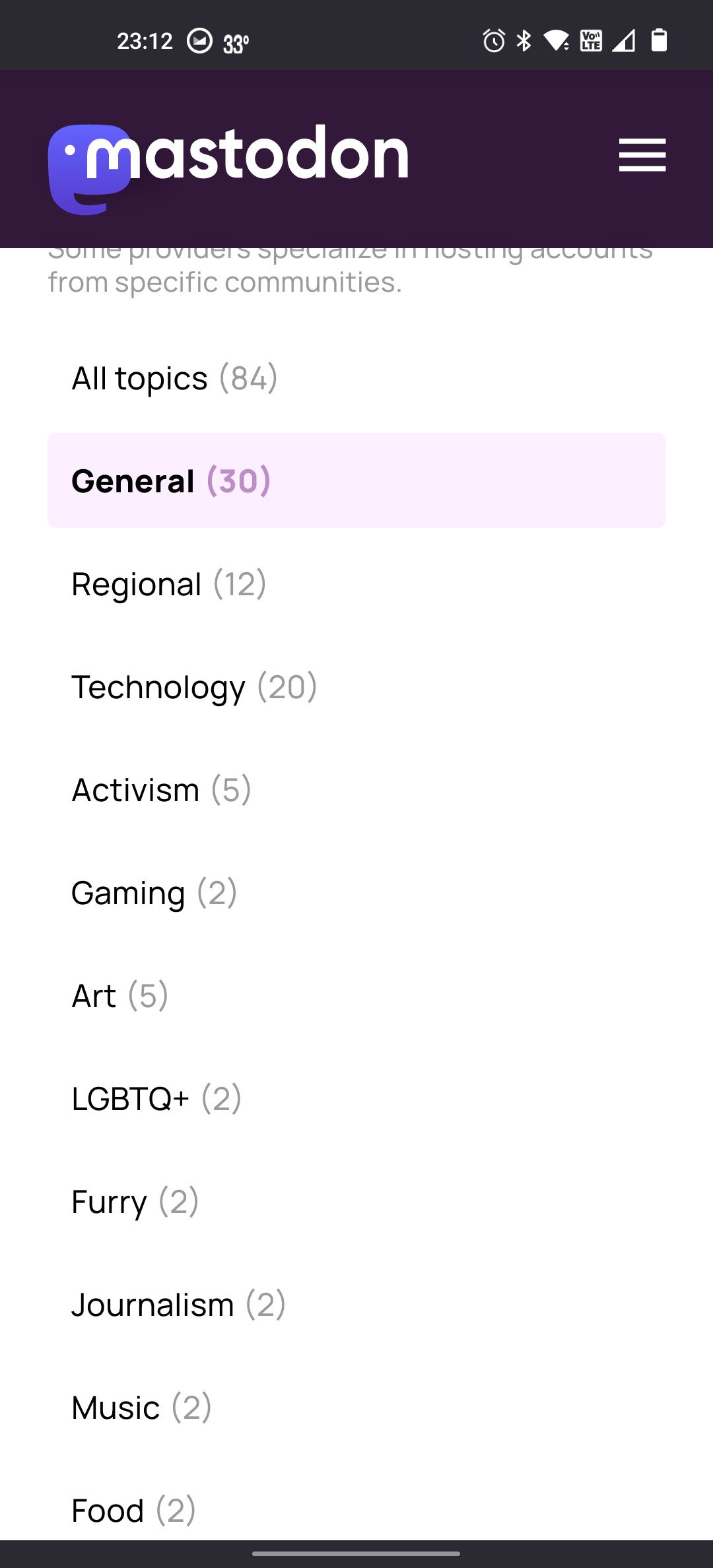
This is the page where you will select your instance. First we want to scroll down to the Topic section of the page (see Image 8):

Image 8: The Topic Section

In this section select the General topic. This will cut the number of servers to less than half of the original list. Note: there are a few categories for special needs you might want to consider, like LGBTQ+ and Activism. These will provide fewer options, but possibly more supportive communities.

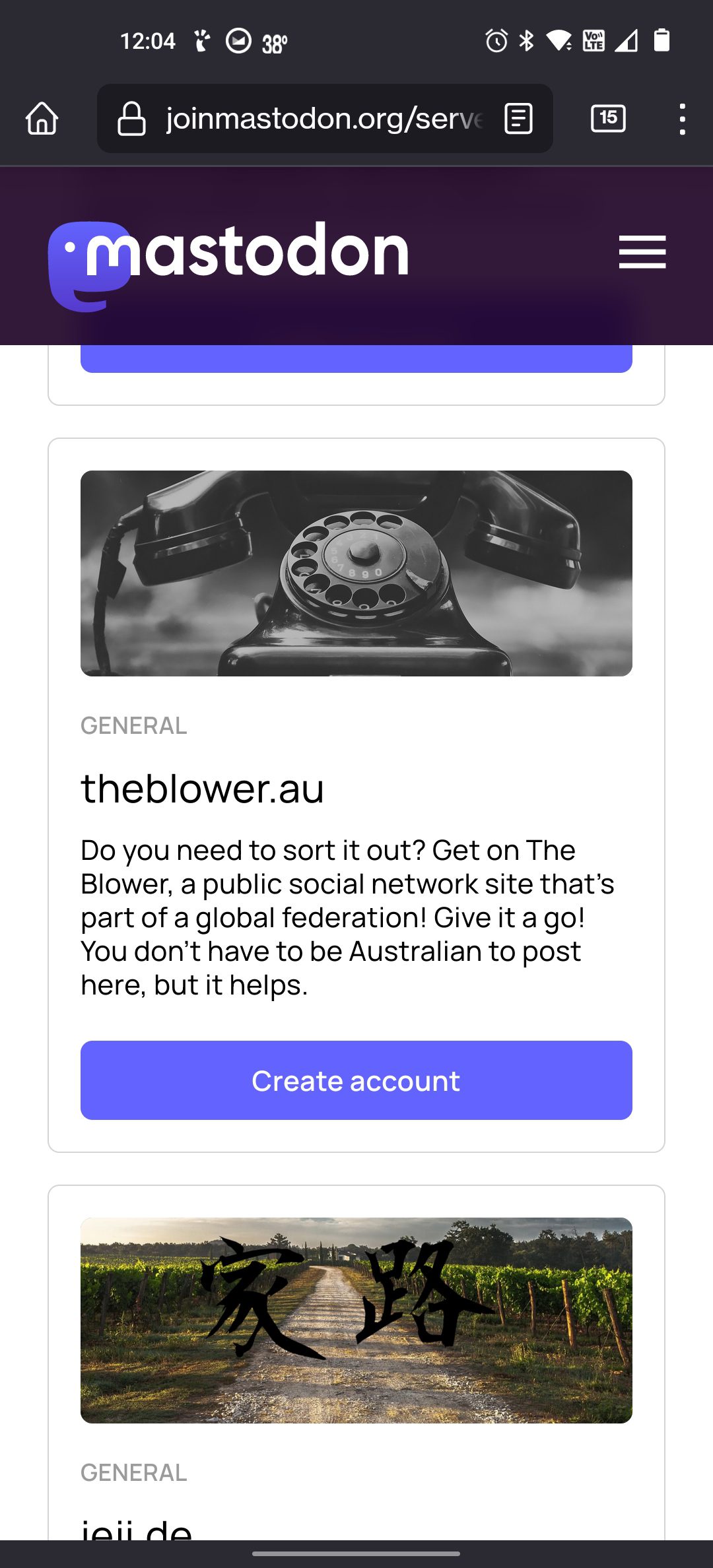
After making your Topic selection, scroll down to pick an instance (see Image 9):

Image 9: Selecting an instance

When you find an instance that sounds appropriate for you, click on the Create account or Apply for an Account button. There is a difference between these two buttons, which do need some explanation:

  • Create Account allows you sign up and log in automatically. Most of the instances in the General category offer instant access.
  • Apply for an Account is used on instances that do a brief screening before granting you access. This is mostly used for special interest servers to make certain that the person is applying for the best reason. For example, the Activism and LGBTQ+ want to be certain that new members won't log in just to attack other members. In some cases the Apply for... button is just used to control the rate at which new users are added to the instance.

So, once you select Create account or Apply for an Account you will be taken to the instance you have selected (see Image 10):

Image 10: The Instance Website

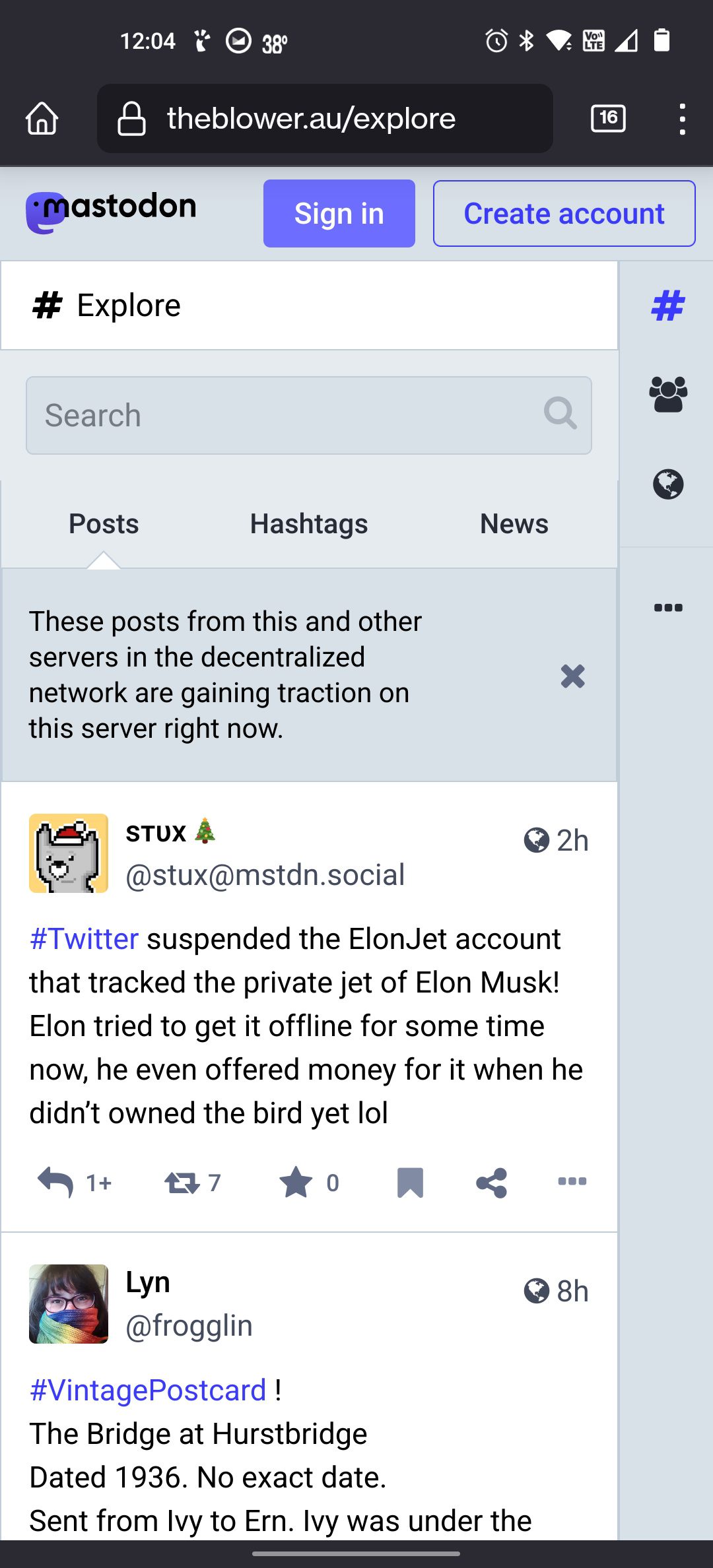
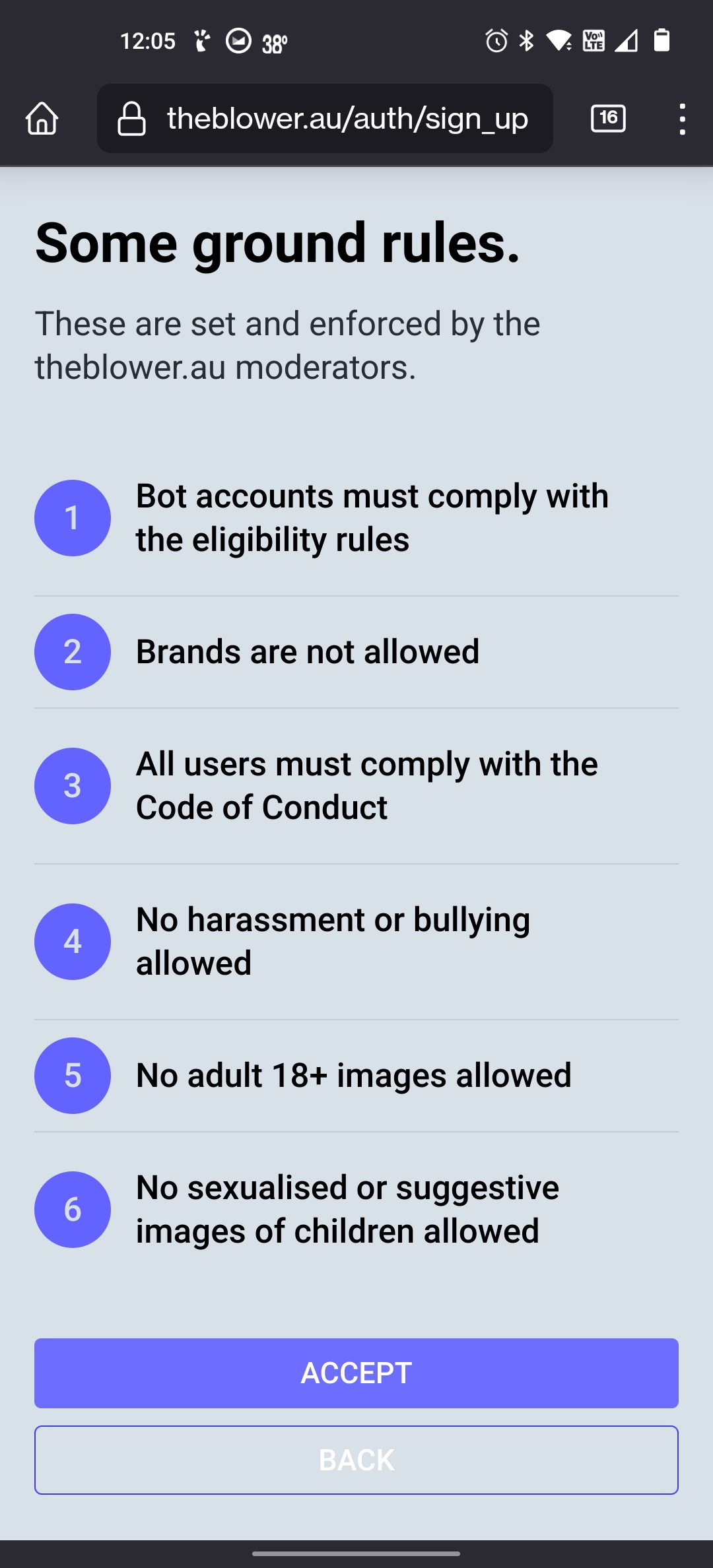
On this page you can look through some of the posts that have been made on the instance recently. When you are ready you can select the Create account button to proceed. You will be shown the rules of the site on the next page (see Image 11):

Image 11: Instance Rules

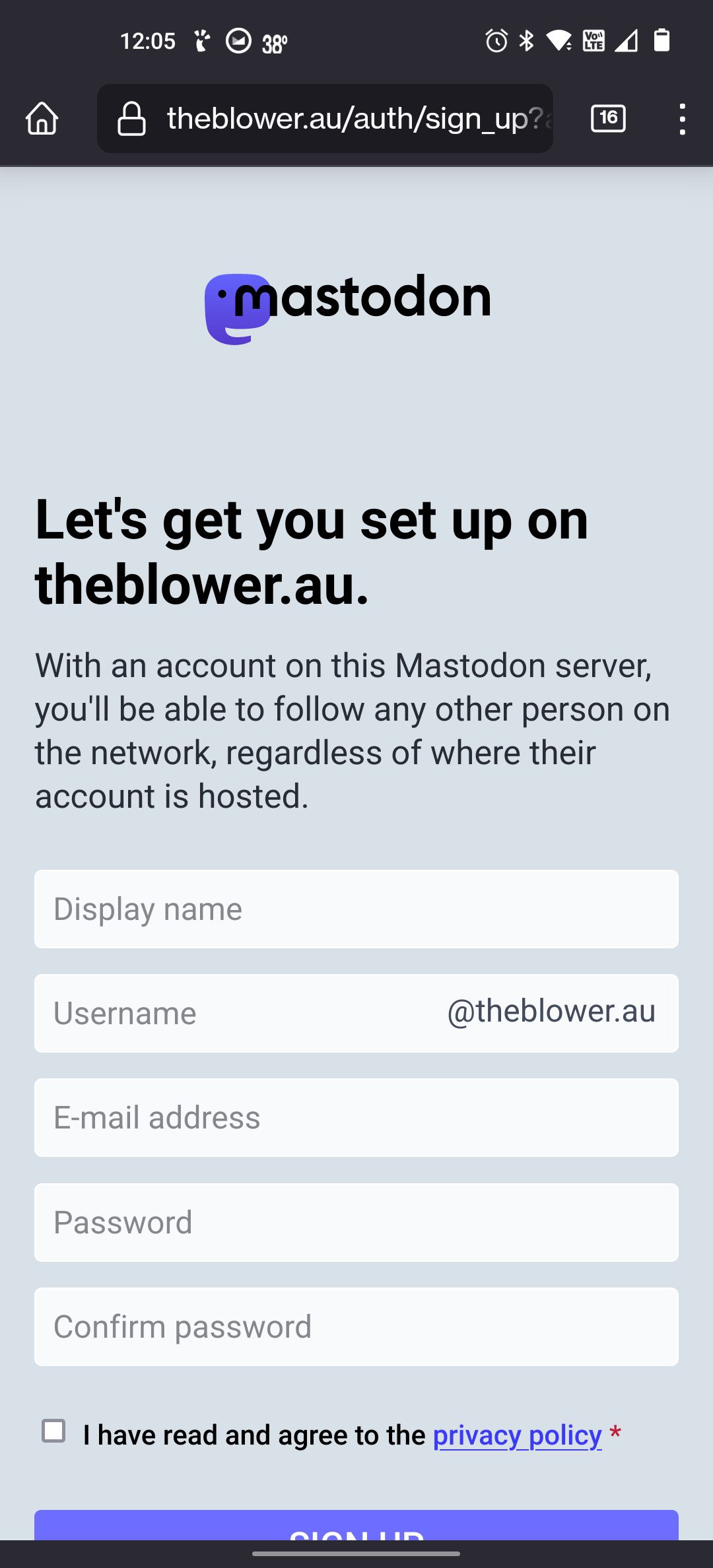
Once you have accepted the rules, you have reached the for creating your account (see Image 12):

Image 12: The Signup Page

And from this point, it's basically the same process as signing up for most other Social Media type websites. You supply a display name, username, email address, and password. Review the privacy policy, and click the Sign-Up button. From this point on you'll follow the instructions to get started with your new Mastodon account.

A Faster Way

So, as I stated before diving into the signup walk through: there is merit to the point that the signup process is complicated / cumbersome. However, there is a workaround for this: skip the part that makes you go through the Join Mastodon interface, and just jump to an instance and create an account. But how can you do that? Well, here's a quick list of some instances that are good general chat instances that you can get started on:

Yes, there are lots more instances to choose from, however these instances are good starting points. Once you get comfortable with Mastodon you can migrate to another instance if you wish (there are instructions in Mastodon's settings for how to migrate).

Once you have signed up for your account, you can use your address to sign in to any app that you have installed on your phone without going through the long process of using the Join Mastodon website.

Conclusion

In this first in a series of articles we've looked at how to sign up for Mastodon. It is admittedly a cumbersome process, but one what was designed to be more flexible and allow new users to select an instance that is the most appropriate for them.

Having considered the signup process, I've included a shortcut list of a half dozen instances that are good places for signing up and investigating what Mastodon has to offer.

In the next article in this series, I'll address some of the other criticisms that I've seen in the press. Having considered those criticisms, we'll move on to discussing what makes Mastodon different from other social media websites.


Categories: #Technology #Features Tags: #elon #elonmusk #mastodon #migration #riptwitter #socialmedia #socialnetwork #twitter #twitterexodus #twittermigration

Originally Published: 2022-043-30 A group of people clinking their glasses together in a celebration toast.

Introduction

Welcome to the start of the new Unattributed website. If by some chance you had stumbled on this website in the past, you might know that it used to be a Tumblr blog. At that time the idea was to share interesting things I found around the web, along with a few of my personal creations. Basically it was a large open bookmark compilation.

Now, however, it's time to move on. The reason for moving on to something else has come about for several reasons:

  • I'm feeling more inspired by the myriad of random information around me.
  • My approach to the internet and more specifically social media, has changed.
  • It was time to revive my websites after several years of hibernation.
  • I needed / wanted to consolidate my sites.

So, let's take the time to explain all of this for the rest of this article.

Getting Inspired

Make anything illustration Photo by Duncan Kidd

Over the past two years I've spent a lot of time doing two things: consuming a lot of media, and writing. This came about for a couple of reasons: the first was my task of taking care of a terminally ill relative, and was followed by the pandemic. But those weren't the only reasons. There were also issues like nearly all of my technology dying within two months (literally my desktop computer, laptop and cell phone), just when a lot of technology became very difficult (or very expensive) to get a hold of. And then there was the 8–9 months spent dealing with the estate of the relative I had been taking care of. Overall, you could say that 2020 wasn't all that great (or productive) of a year for me.

However, I did get to do a fair amount of thinking, planning, writing. This was something that I hadn't really done for quite some time since most of my plans had to center around other things in my life. It wasn't really mine to direct.

The thing that was a real changing point for me, however, came when I was able to start getting some technology together again and started actually working on this. The big things were: (a) I organized a lot of information that had been spread all over the place, (b) I started working on how to put together a work flow for myself, and © I started actually gaming.

Now, gaming might not seem like a big deal. But for me, well, I generally hadn't been much of a gamer before. And I'm still only into lighter games: turn based RPG's, visual novels, simulations, etc. But the thing is this: for me, it served as something on an inspiration, how? It's given me a chance to experience narratives differently. I've long known that games have their own way of presenting narratives. One of the things that I had started consuming quite a bit over the past several years was gaming content on YouTube (in particular Minecraft content, which is now my favorite game).

So, basically, I found that I have more inspiration now: I have a new perspective on things, I have a ton of materials that I've built over an extended period of time (my email archives are around ~2500 messages per year over the last 10 years, my “knowledge” database has over 1000 documents, and I have a bibliography database with hundreds of references in it), and I have a desire to explore a bunch of different concepts and topics in as many forms as I possibly can.

The Internet and Social Media

The Social Media Internet

Partially because of the responsibility to take are of my relative, partially due to limited access to the internet, and partially doe to the failure of most of the surrounding technology, I ended up leaving the internet for a couple of years. More specifically, leaving social media. And I don't regret it. I've come to realize that the time spent doom-scrolling on Twitter, trying to checking things out on Instagram or TikTok, and playing attention games that social media pushes are quite damaging.

The thing is, I've realized that I tend to not function all that well in the social media landscape. The idea that one is trying to come up with short pieces of information that will grab and sustain the attention of thousands or millions of people is just a game I don't do very well. Instead, I function in the world where there is more deliberate and considered thought given to things, or there is a bigger narrative. Consider my approach to be a novel to social media's micro-fiction.

That being said I have found there are some platforms that I tend to like using a bit more: typically these are forums. Forums tend to work better for my because they are specialized in a specific topic, and most of the expression can be more complete than trying to cram something into 250 characters. But as with all things, having something like Twitter is useful at times for more interactive communication: Mastodon is filling that role now. Reddit is also okay to some degree, depending on which Subreddits you are in. PixelFed is a suitable Instagram replacement, not a lot of people posting fancy (fake) influencer shots, just people sharing their pictures / drawings / etc.

The point is: I don't use the social media the way I was before. Now I tend to focus on the things that I want to do, and occasionally pop my head onto a social platform when I want / need to. That's led me to be much more relaxed than I used to be.

Out of Hibernation

Close-Up Photo Of Yawning Cat Photo by Anna Tóth

This is where things get a bit on the geeky side.

Once I knew that I wanted to start working on my websites again I had to make some decisions. There were some things that needed to be addressed:

  • I wasn't happy with the software I was using.
  • I wasn't pleased with one of my hosting services.
  • I needed to move off the free hosting that I was using for some of the sites.
  • I needed to simplify some aspects of managing all my sites.
  • I needed to drop a service(s) that I don't trust.
  • And finally: I needed to re-design things into a workflow that I could work with.

There's a lot more technical details that go into this. I spent quite a bit of time evaluating options before I finally came to a decision. And things actually didn't go quite the way that I expected:

For example: the software. That was actually a sticking point with me. I wanted to get off the software that I was using due to changes making it more difficult to use. And I still feel that way. But there were other things to consider: I've been using this software for nearly a decade at this point. Some more recent changes are actually positive (but they don't undo the negative changes). Looking at other options, I didn't find one that I felt I would be comfortable with (and I went so far as to set up local instances of them and tried porting one of my sites to them — so I put in some time doing serious testing).

The hosting situation was probably the more annoying issue. The host I've been with now for 10 years. I didn't want to hit that milestone. I actually started shutting down services with them several years back, but hadn't finished. So now it was time to start doing research all over again. Fortunately I found a service that can host all my sites, and should cost around as much as it previously cost to host one site. This new hosting service also simplifies a lot of management side of things, and has features that my old hosting hadn't figured out how to do in 10 years (like having staging areas for working on updates).

Services being dropped: I'll be blunt about this one, it's Google. There are just more and more things happening around them that make them a potential liability. A couple of quick examples: Google Analytics is not compliant with recent EU directives, and there is potential liability in using Google Fonts API's. This isn't a matter that I take lightly. I personally haven't been a huge fan of Google for a while now, I don't use their search engine, I try to turn off as much of their stuff on my phone and tablet as possible, and I've been trying to get rid of their analytics everywhere. Also, I've been moving all of my domains to a different registrar (previously some of my domains had been registered with Google out of convenience). So yeah, that's actually a pretty big one.

The thing that I haven't folded into this yet: my approach to social media and the internet. One of the things that I decided when I left social media was to not try to chase things around anymore. I want to focus on my work and not on trying to chase status online. And yet, I still want to get these sites seen by an appropriate audience. Well, it turns out that the Fediverse (which Mastodon is part of) has an answer: they have a publication protocol that can be integrated into these sites...when an article is published the Fediverse will get a copy of it, and it will just look like another Mastodon / Friendica / etc. stream that people can follow.

So that makes a lot of things a lot more streamlined. Sure, I probably won't have “the reach” that other sites have, or that I had in the past. But honestly, that doesn't make a difference, I know that the people that are interested in my work will find it and be able to follow it in a way that is convenient to them.

Conclusion

So, yeah, this was a long way of saying a lot and a little at the same time. Basically, I've given a long explanation of how I have gotten here. What this new beginning is and how it came about. The thing that I am most pleased with is that I have an idea of the things that I want to do. I've found my inspiration again, and I have a lot of ideas that I want to pursue. This site is my opportunity to talk about the things I am pursuing, and present some of the research and information I'm learning along the way.

I'm also happy to have found a way to streamline a lot of these endeavors. Between having a hosting service that helps to pull things together, to finding tools to publish these articles to the Fediverse, there is a lot of time that I can spend working on the articles ant to write, the research that I want to do and dive headlong into any random rabbit holes that I want to.


Categories: #Technology #Features Tags: #celebration #inspiration #revival #socialmedia