Before Angine and King Gizzard there was Harry Partch
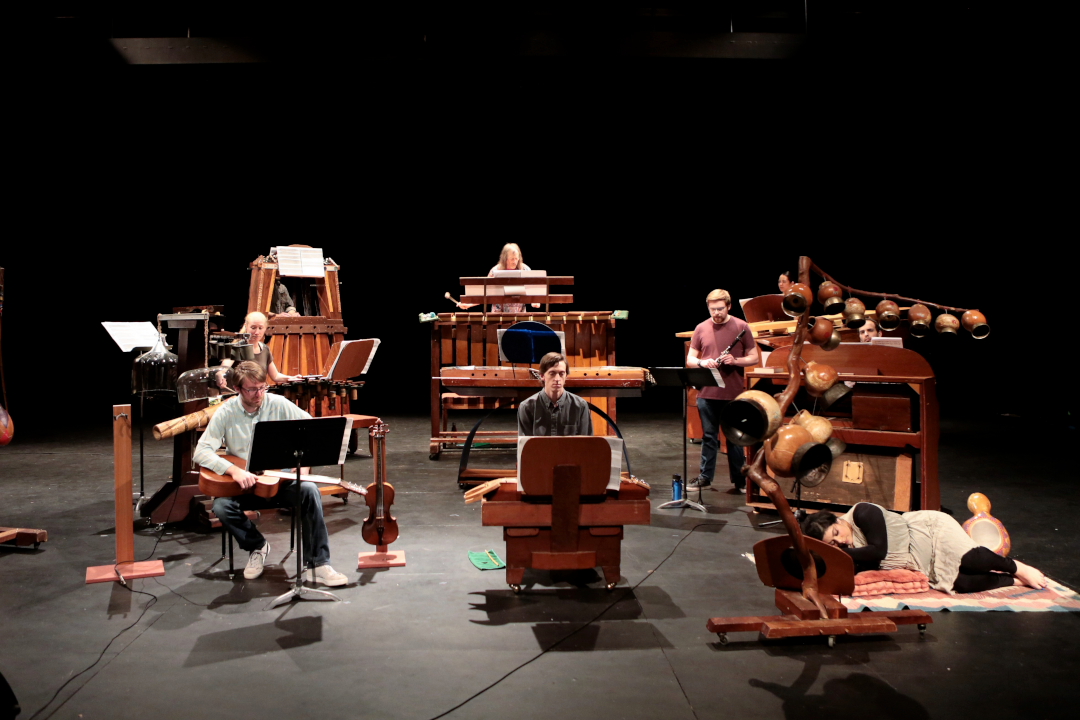 The Harry Partch Ensemble, via Wikipedia, under a CC 0 License.
Listening to Harry Partch is like going on a surreal archaeological dig through history. Only this is history reinterpreted by someone who has been taking shrooms for two decades. Yet, with the emergence of microtonality in the music of King Gizzard and the Lizard Wizard and Angine de Poitrine his works are more relevant today than ever.
Harry Who?
Harry Partch was born on June 24th, 1901 to Virgil Franklin Partch, and his wife Jennie. They were missionaries to China who fled the Boxer Rebellion. His parents settled in Benson, Arizona. He was encouraged by his mother to learn music, and she taught him to read music. He was exposed to music from different cultures including Chinese (via his mother), the Yaqui people, and Spanish songs.
He began studying piano serious in 1913 after his family relocated to Albuquerque, New Mexico. He also began composing his earliest piano works (which he later destroyed). In 1919 He relocated with his mother to Los Angeles after the death of his father. In 1920 his mother was killed in a trolley accident. Partch studied music at the University of Southern California's School of Music in 1920, but left two years later being dissatisfied with the teachers.
Rejection of Equal Temperament
Sometime during the 18th Century, western music settled on the tuning system known as twelve-tone equal temperament. After reading Hermann von Helmholtz's [Sensations of Tone](https://en.wikipedia.org/wiki/SensationsofTone “Sensations of Tone”) in 1923, Partch began to feel that equal temperament had forced music to become more abstract. This abstraction was stifling the true possibilities for expression in music, so he rejected equal temperament in favor of just intonation.
This marked Partch's first step in finding a different direction for musical expression that remains the inspiration for many avant-garde and experimental musicians to this day.
Partch's Journey
Per Wikipedia's entry on Harry Partch, his career can be divided into several periods: Early Work (1919-1947), Academic Period (1947-1962), and his Late Period (1962-1974). These periods roughly correspond with the types of Partch's compositions, and his exploration of tonality.
During the first period, Partch came to reject the system of equal temperament, favoring just intonation instead. His first experiments involved creating paper coverings that indicated just intonation fingerings for violins. In 1930, he decided to break from the equal temperament tradition completely and burned all his previous 12TET (12 tone equal temperament) based compositions. He then devised a 29 tone scale, and had a viola constructed with which to perform works using this scale (the Adapted Viola).
In 1932, he gave several performances of his works in San Francisco, and won the support of a private group of individuals which allowed him to relocate to New York. The Carnegie Corporation of New York granted him the money he needed to continue his studies in England, where he met Kathleen Schlesinger. Schlesinger had been studying ancient Greek music theory, and had recreated a Kithara from an image on a Greek vase. Upon his return to the United States during the great depression, Partch would spend nine years as a transient / hobo. In 1938 constructed his own Kithara approximately twice the size of Schlesinger's and devised a new 43 tone scale. While in Chicago, Partch would design and build a 43 tone reed organ (aka the Chromelodeon).
The second period saw Partch settling into the University of Wisconsin from 1944-1947, during which he lectured, built more instruments, and finished his book Genesis of a Music. He left in 1947 due to not being able to join the permanent staff of the university, and there being a lack of space for his instruments. In 1949, he was offered the opportunity to convert a smithy into a studio by Gunnar Johansen to continue his work. During his work in the smithy, he recorded Eleven Intrusions and several other works. In 1951, he moved to Oakland, CA for health reasons, and put on a performance of his piece King Oedipus, but was unable to make a recording of it due to objections from the Yeats estate. Partch set up his studio / record label Gate 5 in 1953, and would release records via mail order. During this period Partch also started working with the University of Illinois, and was introduced to Danlee Mitchel, who would later become Partch's heir. Partch produced several performances of his works with the University's support. Partch also began what would a six film collaboration with Madeline Tourtelot. Partch left the University due hostility from the music department, despite having support from other departments and organizations.
Partch's final period saw him returning to California, and setting up studio in Petaluma. He composed And on the Seventh Day, Petals Fell in Petaluma. And, in 1969, Columbia Records released The World of Harry Partch, his first major label release. Partch's final theater was The Delusions of the Fury, produced in 1969. His final work was the soundtrack to the Betty Freeman film The Dreamer That Remains. In 1973 Partch retired. He died of a heart attack on September 3rd, 1974.
Partch's Influence
As is, hopefully apparent, Partch's work was both influential and controversial. During his life he was supported by numerous artists, such as Henry Cowell, Otto Leuning, Roy Harris, and Aaron Copeland. He also had the support of numerous foundations, including the Carnegie Corporation of New York, the League of Composers, the Fromm Foundation, John Simon Guggenheim Memorial Foundation.
Towards the end of his life, The Harry Partch Foundation was established to handle his expenses, and administer his work. His instruments. Danlee Mitchel served as the Executive Director of The Harry Partch Foundation until his death. Dean Drummond's group Newband undertook the handling of Partch's instruments and performs with them. The Sousa Archives and Center for American Music holds the Harry Partch Archive 1918-1991.
Partch was inducted into the Percussive Arts Society Hall of Fame in 1974. In 2004 U.S. Highball was selected by the Library of Congress's National Recording Preservation Board.
Closing
While the work of Harry Partch has not seen wide acknowledgment throughout Europe or Eastern Countries, there is growing interest in his work. Partch's work has established a culture where the exploration of alternate tunings for instruments has become something that is more common.
Groups like Angine de Poitrine, and King Gizzard and the Lizard Wizard haven't rejected the concept of equal temperament in their instrument selection. But, they are using the concept of adding more tones to the scale in ways that are substantive, just as Partch developed whole new scales and made large scale compositions with them.
This is the way forward for music. There is an entire world of sound out there waiting to be discovered, or in some cases, rediscovered. Twelve tone equal temperament has been the primary focus of music for centuries. With the advances in synthesizers and sampling over the past several decades, artists have started exploring all sorts of new grounds.
Hopefully, we will see more substantial work done in the field of using just intonation, and other tuning systems.
If you would like to explore the music of Harry Partch, I highly recommend the four volume set: The Harry Partch Collection Vol 1, Vol 2, Vol 3, and Vol 4, along with other recordings of Partch's work on New World Records.
There is also an excellent film of Harry Partch's Studio from around 1950 available on YouTube. This lets you see all of his instruments and provides a deeper understanding of how they were designed. Partch also plays each of the instruments.
Categories: #Music Tags: #experimetnal, #microtonal, #american, #influential License: Copyright Unattributed. Licensed under Creative Commons BY-NC-SA 4.0.
| FediRing | ||
|---|---|---|
| ◀️ Prev | Home | Next ▶️ |